

 ENG
ENG
 English
 русский
 Español
 Türk
Türk

Abstract
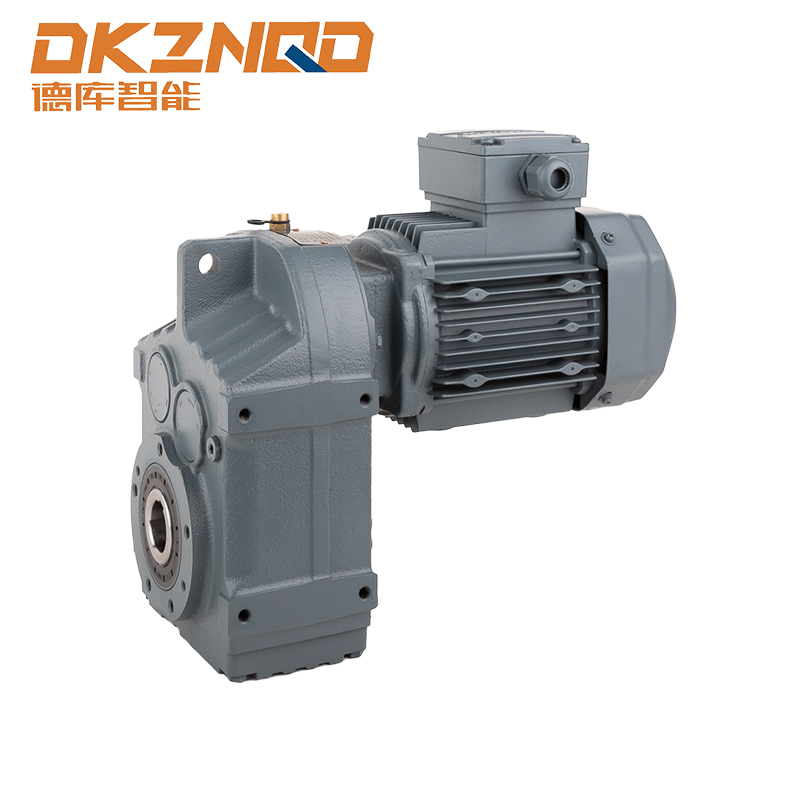
In modern industrial systems, motion power transmission subsystems must deliver increasing performance within tighter spatial and energy constraints. The F series parallel shaft helical gear motor has emerged as a common architectural choice in sectors ranging from automation and robotics to material handling and processing equipment.
1. Industry Context and Application Importance
1.1 Industrial Motion Systems: Requirements and Trends
Industrial motion systems increasingly face multidimensional pressures:
- Higher throughput demands
- Stricter space and weight limitations
- Greater overall energy efficiency
- Improved reliability and reduced maintenance costs
In this landscape, gear motor subsystems are critical: they convert electrical power into controlled mechanical motion with desired speed and torque characteristics. The parallel shaft helical architecture in the F series parallel shaft helical gear motor supports favorable trade‑offs between load capacity, noise, smoothness, and physical size compared to other gear configurations.
1.2 Typical Market Segments and Use Cases
Key sectors where F series parallel shaft helical gear motors play a central role include:
- Automated material handling systems
- Conveyor drives in processing plants
- Packaging machinery
- Robotic joints and actuators
- Textile and printing equipment
- Pumps and mixers in processing industries
In each application, the ability of the gearbox‑motor assembly to deliver high torque in confined volumes directly affects system throughput, rack/panel space, and installation cost.
1.3 Why Torque and Compactness Matter
Torque and compactness are not merely product performance parameters; they define system integrability, efficiency, and total cost of ownership:
-
Higher torque density enables:
- Smaller actuators per unit task
- Lower mass and inertia
- Fewer mechanical stages
-
Compact footprint reduces:
- Space on factory floors
- Weight on moving axes
- Auxiliary support structures
Both characteristics shape system dynamics, control precision, and lifecycle economics.
2. Core Technical Challenges in the Industry
Despite progress, several persistent challenges affect enhancements in torque and physical size:
2.1 Mechanical Strength vs. Size Constraints
At the heart of the torque density challenge is the material and geometry trade‑off:
- Gear tooth contact surfaces must withstand high cyclic loads.
- Reducing size often reduces allowable tooth flank area, lowering load capacity.
This drives the need for advanced materials, optimized tooth profiles, and enhanced manufacturing accuracy.
2.2 Heat Accumulation and Efficiency Loss
Compact gear motors are more prone to thermal concentration:
- Smaller enclosures trap heat.
- High torque periods increase losses in bearings, gear meshes, and motors.
Without effective heat dissipation, efficiency and service life degrade.
2.3 Noise and Vibration Control
High torque in confined assemblies tends to exacerbate:
- Gear mesh noise
- Shaft deflection
- Bearing fatigue
Achieving low noise and smooth operation within a compact architecture is non‑trivial.
2.4 Integration with Power Electronics and Control
Electric motor performance interplays with gearbox behavior:
- Motor torque/speed curves must align with gear ratios and load profiles.
- Compact drives often lack space for advanced cooling or oversized drives.
System designers must consider electrical, mechanical, and thermal domains simultaneously.
3. Key Technical Paths and System‑Level Solutions
To overcome these challenges, manufacturers pursue multiple technology pathways, often in combination.
3.1 Gear Geometry Optimization
Gear design remains foundational:
3.1.1 Advanced Tooth Profiles
- Asymmetric and modified involute profiles improve load sharing across surfaces.
- Better meshing reduces peak stresses and enables higher torque capacity without size growth.
3.1.2 Helical Angle and Overlap Considerations
- Higher helix angles increase tooth overlap and load distribution.
- Proper helical design can mitigate axial loads while enhancing torque capacity.
These design strategies often rely on computer‑aided optimization and simulation to balance strength, efficiency, and manufacturability.
3.2 Materials and Surface Engineering
Material selection and post‑processing significantly affect torque limits:
3.2.1 High‑Strength Alloys
Using alloy steels with enhanced mechanical properties increases permissible load per unit volume.
3.2.2 Surface Treatments
Processes such as:
- Carburizing
- Nitriding
- Shot peening
Enhance surface hardness and fatigue life, enabling higher torque levels without enlarging components.
3.3 Compact Bearing Systems
Bearings support gear loads and influence mounting envelope.
- Tapered roller bearings support high radial and axial loads.
- Hybrid ceramic bearings reduce friction and allow tighter fits in small spaces.
Selecting bearing systems tuned to expected load spectra supports both compact design and torque handling.
3.4 Motor‑Gearbox Integration
The system is greater than the sum of parts:
- Co‑designed motor and gearbox allow optimized shaft interfaces and minimized dead space.
- Integrated cooling channels reduce junction temperatures without external add‑ons.
This tight integration improves power density and control responsiveness.
3.5 Advanced Manufacturing and Precision Assembly
Micro‑level manufacturing improvements translate to macro‑level performance gains:
- CNC grinding of gear teeth yields better surface finish and reduced backlash.
- Precision assembly reduces unintended clearances and misalignments that degrade torque transmission.
Together, these techniques enable consistent, high‑performance builds at industrial scales.
3.6 Thermal Management Strategies
Heat management in compact systems is crucial for sustained torque delivery:
- High‑conductivity housings improve heat flow to ambient.
- Internal heat paths (e.g., fins, cooling tubes) dissipate heat generated at gear meshes and motors.
Effective thermal management maintains efficiency and component life.
4. Typical Application Scenarios and System Architecture Analysis
Enhancements in torque and compactness are realized differently depending on application context.
4.1 Conveyor Systems
Requirements:
- Long operating hours
- Variable load profiles
- Tight spatial envelope
System Approach Example:
| Subsystem | Key Requirement | Design Consideration |
|---|---|---|
| Gearbox | High starting torque | Optimized helix and tooth surface treatment |
| Motor | Low‑speed high torque | Integrated electric motor sizing |
| Thermal | Continuous duty | Housing conduction and ambient convection |
| Control | Smooth start/stop | Soft start and feedback loop |
In conveyors, the F series parallel shaft helical gear motor must support start‑up inrush torque while maintaining low vibration, demanding compact high‑capacity gearing and stable thermal behavior.
4.2 Robotic Actuation
Requirements:
- Precision motion
- Low inertia
- Space‑limited joints
System Approach:
Robotic joints benefit from high torque density to minimize actuator size and inertia, enabling faster response and lower energy consumption. Precision gear geometry and tight motor alignment are critical here.
4.3 Vertical Lifts and Handling Systems
Requirements:
- Stable lifting under load
- Safety and redundancy
- Compact footprint
System Approach:
Parallel shaft helical gear motors combine structural rigidity with ability to deliver sustained torque under variable loads. Thermal and vibration management directly affect lift stability and safety margins.
5. Technical Solution Impacts on System Performance
Understanding how design choices influence system performance is key for engineering decision‑making.
5.1 Torque Output and Control Precision
Enhanced gear geometry and materials increase the continuous and peak torque capacity of drives, enabling:
- More aggressive acceleration profiles
- Better load holding
- Reduced gear train shifts under dynamic loads
These improvements support precise motion control in advanced automation systems.
5.2 Reliability and Lifecycle Performance
Advanced bearings and surface treatments improve fatigue resistance and reduce downtime. Compact designs with robust thermal paths minimize failure mechanisms, directly lowering maintenance burden.
5.3 Energy Efficiency
Well‑designed gears and motors minimize losses:
- Efficient meshing reduces friction
- Reduced backlash limits wasted motion
- Better cooling maintains optimal motor efficiency
These factors translate to lower operational cost per unit work.
5.4 System Integration and Total Cost of Ownership
Compact, high‑performance F series parallel shaft helical gear motors reduce ancillary hardware requirements: smaller housings, fewer supports, and lighter structural frames. This lowers procurement, installation, and operating costs.
6. Industry Development Trends and Future Directions
Looking forward, several trends converge to shape future evolution:
6.1 Digital Twin and Simulation‑Driven Design
Digital models enable:
- Predictive stress and thermal mapping
- Virtual optimization of torque density
- Reduced physical prototyping cycles
Simulation tools are becoming integrated into design workflows rather than just analysis.
6.2 Smart Sensor Integration
Embedded sensors for:
- Vibration
- Temperature
- Load forecasting
offer real‑time health monitoring, enabling predictive maintenance and improved uptime.
6.3 Materials Innovation
Emerging materials and coatings promise:
- Higher specific strength
- Improved wear resistance
- Lower friction interfaces
This could push torque density beyond current material limits.
6.4 Modular and Configurable Subsystems
Future systems will emphasize modularity, allowing stakeholders to tailor torque, ratio, and footprint from standardized building blocks. This supports rapid deployment and flexible system scaling.
7. Summary: System‑Level Value and Engineering Significance
Enhancing torque and compactness in F series parallel shaft helical gear motors is not primarily a product engineering exercise—it is a system engineering challenge that affects:
- Mechanical robustness
- Thermal dynamics
- Control precision
- Lifecycle economics
By applying multidisciplinary strategies—advanced geometry, materials science, manufacturing precision, and integrated thermal/electrical design—manufacturers push performance frontiers while aligning with application demands in automation, robotics, and processing systems. For system integrators and technical buyers, understanding these approaches enables smarter specification, integration, and long‑term performance assurance.
8. Frequently Asked Questions (FAQ)
Q1: What does “torque density” mean in gear motors?
Torque density refers to the amount of torque a gear motor can deliver relative to its size or volume. Higher torque density enables more compact designs without sacrificing performance.
Q2: How does gear tooth profile optimization improve performance?
Optimized tooth profiles distribute load more evenly across gear surfaces, reducing stress concentrations and enabling higher torque capacity with less wear.
Q3: Why is thermal management critical for compact gear motors?
Compact systems have limited surface area for heat dissipation. Without effective thermal paths, components can overheat, reducing efficiency and service life.
Q4: Can sensor integration improve reliability?
Yes. Integrated sensors provide data for condition monitoring and predictive maintenance, helping prevent unplanned downtime.
Q5: Are parallel shaft gear motors suitable for high‑precision motion?
When designed with tight tolerances and advanced tooth geometries, parallel shaft gear motors can support precise motion, especially in applications where low backlash and smooth torque are critical.
9. References
- Industry analysis on gear motor trends and market drivers.
- Engineering literature on gear geometry and tooth profile optimization.
- Technical resources on thermal management in compact electromechanical systems.
 05 Jun,2025