

 ENG
ENG
 English
 русский
 Español
 Türk
Türk

A packaging line stops twice a month. A mixer needs a new gearbox every eighteen months. In most cases like these, the failed reducer was not undersized on ratio — it was undersized on torque, because the service factor never matched the real duty. That is the first rule of choosing a gear reducer: treat it as a structural component of the machine, not as a speed-changing accessory.
A correctly selected reducer balances four things: output torque and service factor, speed ratio and efficiency, mounting and environmental fit, and lifecycle cost. This guide works through all four in the same sequence a drive engineer follows when sizing a unit for a real production line. Apply this sequence before opening a catalog, and the most common selection mistakes disappear.
Key rule: define the required output torque with the correct service factor first, then work through ratio, mounting, environment, and lifecycle cost. A catalog ratio alone never selects a reducer.
Start with the Load and the Service Factor
The load is the starting point. Calculate the torque required at the output shaft: the running torque of the driven machine, plus the inertial load during starting and stopping, plus a realistic allowance for how the machine will be loaded in daily production. Output torque in Nm is the single most important number in any selection, which is why experienced engineers always ask for the duty description first and the motor power second.
The service factor covers the gap between a catalog rating and real operating conditions. It is a multiplier applied to the required output torque. A unit rated for a service factor of 1.0 is correctly sized only for continuous, uniform load; any shock, reversing duty, or high inertia demands more margin.
| Duty class | Typical applications | Service factor |
|---|---|---|
| Uniform, continuous | Light conveyors, fans, generators | 1.00-1.25 |
| Moderate shock | Mixers, agitators, cranes | 1.25-1.50 |
| Heavy shock | Crushers, shredders, presses | 1.50-2.00 |
| Reversing or high inertia | Positioning drives, indexing tables | 2.00 and above |
Once the required torque is adjusted by the appropriate service factor, compare it with the rated torque of each candidate reducer. When two quotes list the same nominal ratio but different torque ratings, the difference sits in gear quality, housing rigidity, bearing size, and manufacturing tolerances, not in the ratio.
Match the Ratio, Output Speed, and Efficiency
The ratio is straightforward: divide the input speed by the required output speed. Efficiency is where the real trade-offs appear. Efficiency determines how much of the input power reaches the output shaft, and different gear technologies behave very differently. On a continuously running drive, an efficiency difference of a few percent shows up directly as energy cost and heat.
| Reducer type | Typical efficiency | Practical ratio range | Shaft arrangement |
|---|---|---|---|
| Inline helical (R series) | 95-98% | Up to 300:1 | Parallel |
| Helical bevel (K series) | 94-97% | Up to 200:1 | Right-angle |
| Helical worm (S series) | 85-92% | Up to 300:1 | Right-angle |
| Worm (RV series) | 50-90% | Up to 100:1 | Right-angle, compact |
| Hypoid (BKM series) | 85-93% | Up to 60:1 | Right-angle, low noise |
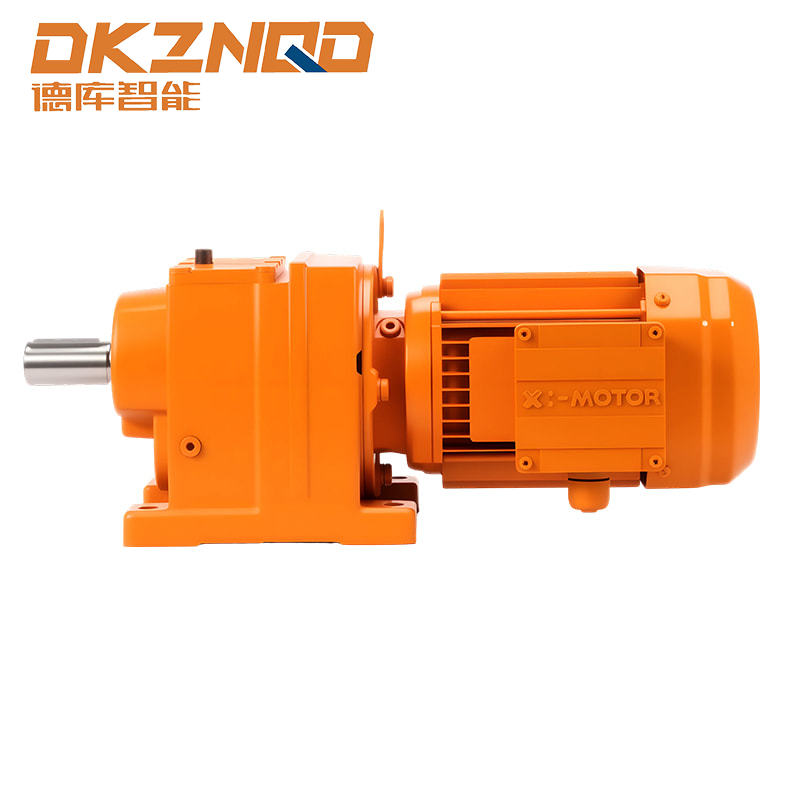
For most parallel-shaft and conveyor applications, an inline helical gearmotor such as the R series gives the highest efficiency, with hardened and ground gears, quiet operation, and a long service life. It is the most common first choice when nothing forces a right-angle arrangement.
R Series Inline Helical Gearmotor with Multiple Stages and Power OptionsThis single-stage helical gear reduction motor suits parallel-shaft and conveyor drives where high efficiency and quiet operation matter. Its broad power range and torque capacity make it a reliable choice for their first-line applications.View Product →
When the drive axis must turn 90 degrees — typical for mixers, bucket elevators, and pallet conveyors — a helical bevel gearmotor such as the K series provides the right-angle output without sacrificing the efficiency and torque capacity of the helical stages, so it handles shock loads better than a worm alternative.
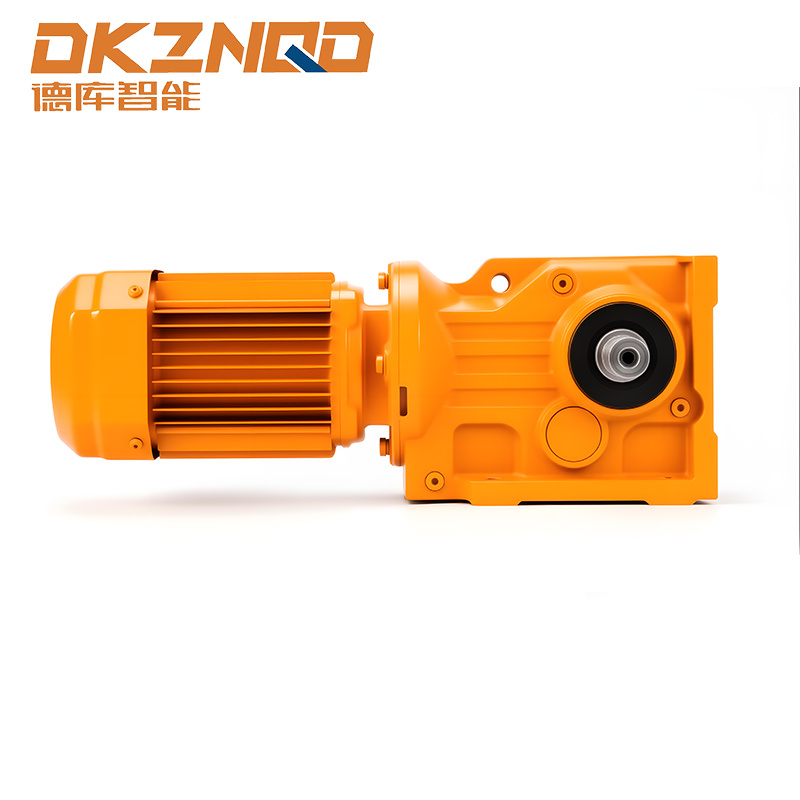 K Series Right-Angle Helical Bevel Gearmotor for Shock LoadsWhen a 90-degree output is required, this gearmotor provides the efficiency and torque capacity of helical stages with right-angle geometry. Its high torque rating helps handle shock loads better than worm alternatives in mixers and conveyors.View Product →
A worm reducer is cheaper and compact, but its efficiency drops quickly at higher ratios, sometimes into the 60 percent range. A BKM hypoid reducer keeps the same compact right-angle layout while recovering most of that lost efficiency, which is why it has become a common replacement for traditional worm drives in modern machinery.
Check the Motor, Mounting, and Operating Environment
The reducer never works alone. Its motor must be compatible with the supply voltage, the control method, and the starting duty. Confirm whether the application needs a brake motor for holding duty, a motor rated for variable-frequency-drive operation, or a standard induction motor with the correct enclosure class for the site.
Mounting position is decided before the reducer is ordered, not after. Whether the unit sits with feet down, output shaft vertical, or flange pointing upward changes the oil level, the breather position, and the bearing lubrication. The ISO M1-M6 mounting positions exist to remove this guesswork, so specify the exact position on the order and on the dimensional drawing.
The environment determines sealing and materials. Dust, humidity, washdown chemicals, and ambient temperature all influence seal selection, paint finish, and oil grade. In a washdown area, the motor enclosure and the shaft seals matter as much as the gear rating.
For machines where space is tight, an S series helical worm gearmotor offers a short right-angle package: the worm stage delivers the high ratio, while the helical stage recovers efficiency and quietness. It fits where a full bevel unit would not, and it remains a practical option in the moderate-duty range.
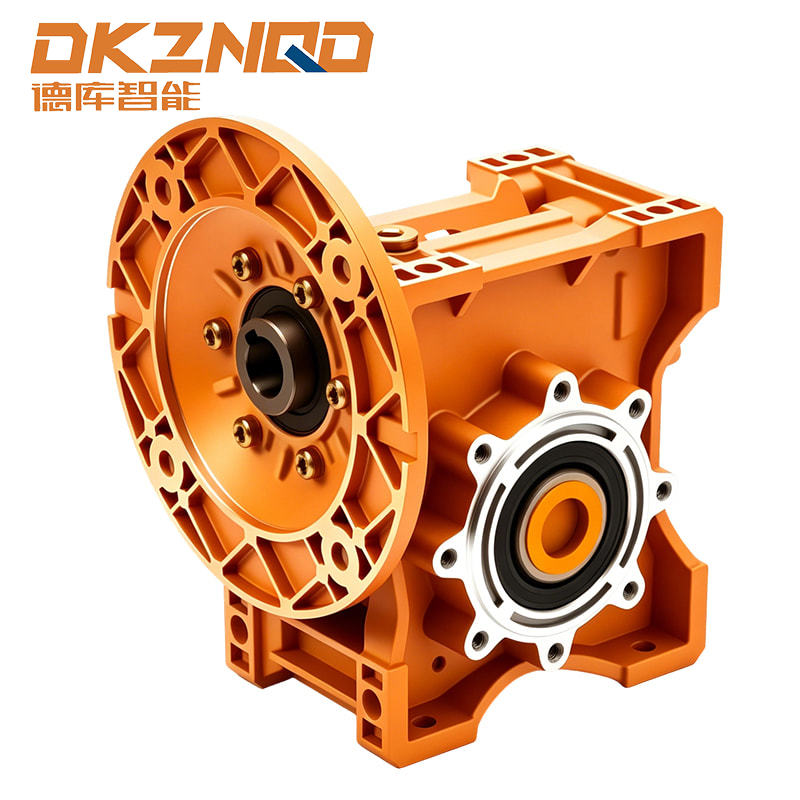 S Series Compact Helical Worm Gearmotor for Tight SpacesThis gearmotor combines a worm stage for high reduction with a helical stage for improved efficiency and quieter operation. It offers a compact right-angle package for moderate-duty machines where space is limited.View Product →
Evaluate Gear Accuracy and Backlash Requirements
For machines that index, position, or hold a load — packaging, cutting, printing, and robotics — the measurable criteria are gear accuracy and backlash. Standard industrial reducers typically offer backlash measured in arcminutes, and positioning applications need to know that value precisely before installation.
The gear accuracy grade defines the tooth-to-tooth and cumulative error in the gear geometry, and it directly affects repeatability and noise. If you are selecting a reducer for a servo or positioning axis, ask the manufacturer for the accuracy grade and the backlash class in arcminutes, then compare both with your positioning tolerance.
A cheaper unit that misses the required accuracy class leads to expensive rework during control tuning and, later, to inconsistent product quality. This is not a place where cutting cost pays off.
Plan for Durability, Maintenance, and Total Cost
Long service life is designed in: hardened and ground tooth flanks, a rigid housing that keeps the shafts aligned under load, bearings sized for overhung forces, and seals that keep contamination out and oil in. When comparing quotes, check the rated service life in operating hours at your selected service factor, not just the nominal torque.
Maintenance design matters as well. Note the oil type and change interval, the breather and drain positions, and whether the lubricant can be serviced while the reducer stays mounted. A design that forces partial machine dismantling for an oil change inflates the true cost of ownership.
Total cost of ownership usually decides the real winner. A low-priced worm unit can waste 10 to 20 percent of the input power as heat on continuous duty, and that loss can exceed the initial price difference within the first year or two. The economical choice is the most efficient unit that still fits the budget and the duty, not the cheapest first quote.
Choose a Supplier with Engineering Support and Custom Capability
A catalog can list ratings; only an experienced manufacturer can help you verify them for your specific duty. The selection process goes much smoother when the supplier asks about the load, the environment, and the start-stop pattern before offering a unit.
Manufacturing depth matters too. A company that cuts its own gears and machines its own housings can adjust shafts, flanges, ratios, and output options without compromising quality, and it can supply non-standard hardened gear reducers when a standard catalog size does not fit.
A manufacturer with 21 years in the gear drive industry and in-house machining, assembly, and testing — such as Deku Intelligent Drive — can take the duty parameters described in this guide and return a unit matched to the machine rather than a generic off-the-shelf guess.
Finally, confirm the supporting documents: test reports, material certificates, warranty terms, and spare parts availability. A durable gear reducer is one whose manufacturer can still be reached after the sale.
Frequently Asked Questions
Q1: What is the most important specification when choosing a gear reducer?
Output torque multiplied by the correct service factor. The ratio tells you the speed, but torque decides whether the reducer survives the load. Undersizing on torque is the most common cause of early gearbox failure.
Q2: How do I choose between helical, bevel-helical, worm, and hypoid types?
Start with the shaft arrangement. Parallel input and output call for an inline helical unit. Right-angle output with efficiency and shock resistance calls for a helical bevel unit. Where space or budget pushes back, a helical worm or hypoid unit offers a reasonable compromise, but compare efficiency and service life at your duty point first.
Q3: Can I replace a worm gear reducer with a helical bevel reducer?
In most cases, yes, but the mounting is different. Check the ratio, torque rating, output shaft dimensions, and overall frame size against your current unit and base plate. The helical bevel unit runs more efficiently and at a lower temperature, which often allows a smaller motor, but its external dimensions differ from a worm unit.
Q4: Is a higher service factor always better?
No. A higher service factor increases frame size, weight, and cost, and it can force a larger coupling or base plate on the driven machine. Select the smallest unit that comfortably covers the duty class with a reasonable margin.
 05 Jun,2025