

 ENG
ENG
 English
 русский
 Español
 Türk
Türk

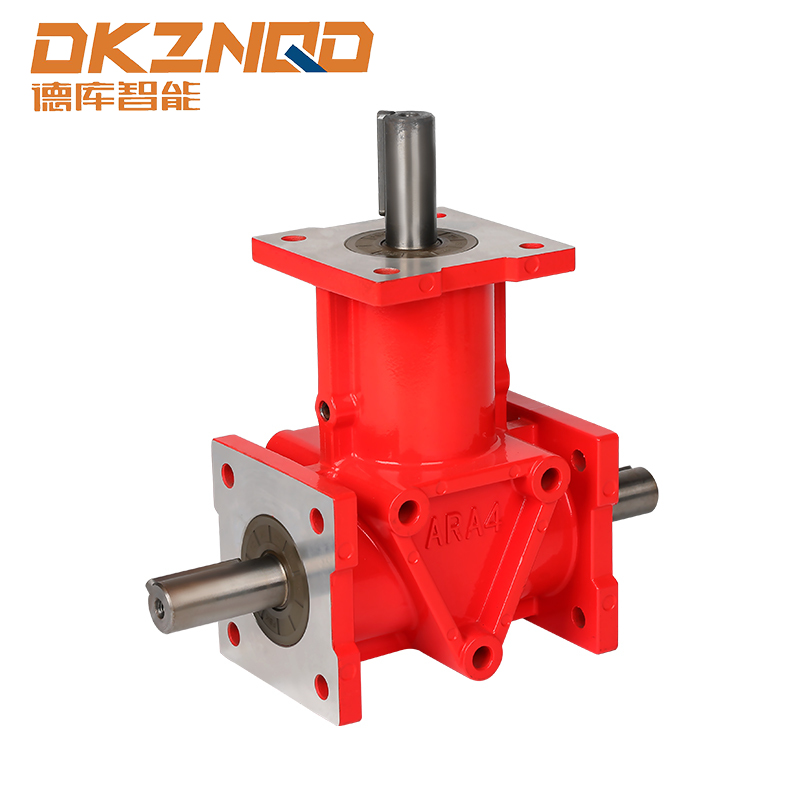
Planetary gearboxes are not a niche novelty. They are the quiet workhorses behind many high-precision machines, from robotics to wind turbine pitch drives. If you need a high reduction ratio in a small envelope, a planetary gearbox is often the first choice. But it is not always the only choice. Understanding how it works, where it shines, and where it struggles will help you make a defensible purchase decision.
What Is a Planetary Gearbox?
A planetary gearbox is an epicyclic gear train that uses a central sun gear, a set of planet gears, a carrier, and an internal ring gear. The planet gears rotate around the sun gear and mesh with the ring gear on their outer side. Because the load is shared across multiple planets, each gear tooth experiences far less stress than in a conventional parallel-shaft reducer. This is why a planetary gearbox can deliver a high torque density in a relatively small housing.
The arrangement also gives engineers great flexibility. By holding one component and driving another, you can produce many different transmission ratios and even reversing or differential outputs. The closer the gear mesh, the higher the proportion of torque that can be passed, which is why planetary designs are preferred in the most demanding servo and precision applications.
How a Planetary Gearbox Works
Think of a solar system. The sun gear acts as the input. The planet gears are then carried by a planet carrier, which often becomes the output. The internal ring gear surrounds the planets and may be fixed, driven, or used as the output. This arrangement creates a kinematic relationship between three different rotating speeds. For a fixed ring gear and a sun gear input, the carrier output gives a reduction ratio calculated from the number of teeth on the ring and sun gears.
For a fixed ring gear, the basic ratio is i = (Zr + Zs) / Zs, where Zr is the number of ring gear teeth and Zs is the number of sun gear teeth. If your ring gear has 80 teeth and your sun gear has 20 teeth, you get a ratio of 5:1. That means the carrier will turn five times slower than the sun gear, but the output torque will correspondingly increase. The formula also tells you that the gear ratio depends only on tooth counts, not on the pitch diameter, which gives designers a predictable path to the exact ratio.
In practice, a single stage can deliver a ratio anywhere from about 3:1 to about 10:1. For higher ratios, manufacturers can stack multiple stages. Each stage adds a set of planets, allowing the reducer to achieve large reductions in a still compact axial length. Since the axes of the input and output are collinear, the planetary gearbox is an in-line solution, which makes it ideal in space-constrained machinery.
If your application requires the same robust, high-torque performance but can accept a different footprint, our industrial gearbox range offers a cost-effective alternative.
 Industrial Gearbox for High-Torque Power TransmissionThis industrial gearbox range provides a cost-effective alternative for applications requiring robust high-torque performance with a different footprint, supporting efficient and reliable operation.View Product →
Key Advantages of Planetary Gearboxes
The main advantages are straightforward. Planetary gearboxes offer high torque density, compactness, and excellent precision. Because the planets share the load, the gear mesh is also relatively quiet and has low vibration. They are known for high efficiency in a small unit, which is great for battery-driven or servo-driven systems.
Below is a quick comparison between a typical planetary gearbox and a single-stage helical parallel shaft reducer for similar torque output.
| Feature | Planetary Gearbox | Parallel Shaft Helical |
|---|---|---|
| Torque density | High | Moderate |
| Length | Compact | Longer |
| Backlash | Low to very low | Moderate to low |
| Efficiency per stage | 97% to 99% | 94% to 97% |
| Cost for high ratio | Higher | Lower |
This table makes it clear that if maximum torque density and axial alignment are your priorities, a planetary gearbox is the superior choice. But if cost, simplicity, and ease of maintenance matter more, a helical reducer can be a pragmatic option.
Common Types of Planetary Gearboxes
Planetary gearboxes come in several configurations. Single-stage units provide moderate ratios. Multi-stage units stack additional planet sets to achieve very high ratios. In-line planetary gearboxes keep input and output coaxial. Offset and right-angle variants allow designers to route power in different directions. Harmonic drives are a special subclass that use a flexible spline, but they are not the same as a standard planetary gearbox.
Each type carries its own trade-offs. A right-angle planetary gearbox must use bevel gears at the input stage, which introduces a bit of backlash and noise. For many industrial applications that do not require a coaxial output, a separate right-angle bevel gearbox can provide the same torque routing without the cost of a complete planetary package.
Planetary Gearbox Limitations
No transmission system is perfect. Planetary gearboxes require tight manufacturing tolerances, especially for the gear mesh and backlash. The multiple planets require precise assembly and careful lubrication, because if the load is not shared equally, one planet can wear significantly faster than the others. This leads to a higher initial cost compared with a simple worm or helical reducer.
The design also means the sun gear and the planet bearings are heavily loaded. For dirty or dusty environments, sealing and maintenance become more challenging. In some lower-torque applications, a spiral bevel or hypoid gearmotor can deliver adequate performance with a simpler and more serviceable package. For example, K series helical-bevel gearmotors offer right-angle output with strong torque and a well-proven lubricating system.
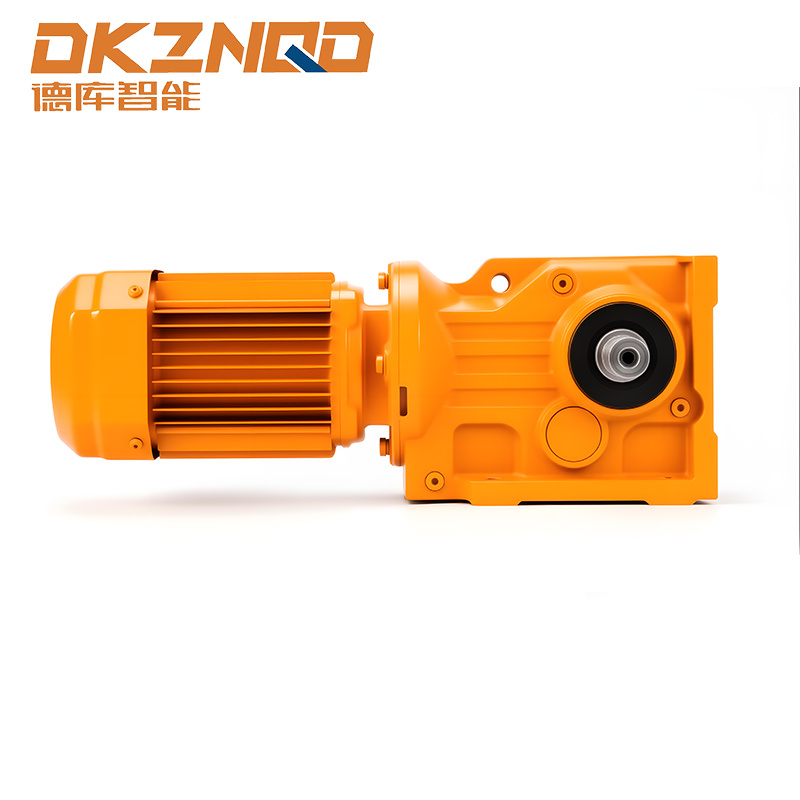 K Series Helical Bevel Gear Motor for Right-Angle DrivesThis gear motor delivers right-angle output with strong torque and proven lubrication, suitable for space-constrained applications where a compact, efficient drive is needed.View Product →
How to Choose Between Planetary and Other Gearboxes
The decision should start with the output requirements. If you need a very high ratio, consistent position accuracy, and compact coaxial design, choose planetary. If you need a simple, low-cost solution and can accept a longer frame or a different axis, a helical or worm reducer often wins. The application direction is critical: for right-angle drives, a K-series or a BKM hypoid unit may be better than a planetary package.
For example, a rotary indexer table often needs a low-backlash planetary gearbox because position repeatability is critical. A horizontal conveyor with moderate torque is usually better served by an R-series helical geared motor, which is simpler to service and less expensive. If space is tight and the axis must change by 90 degrees, a BKM hypoid gear reducer or a K-series helical-bevel unit could give you the compact footprint you need without the complexity of a full planetary train.
BKM hypoid gear reducers are an interesting alternative in this space. They use a hypoid gear set that combines the efficiency of helical gearing with the right-angle geometry of a worm drive. This allows a compact design, quiet operation, and lower backlash than a standard worm reducer. For many moderate-torque machines, a BKM unit can replace a planetary gearbox at a lower total cost.
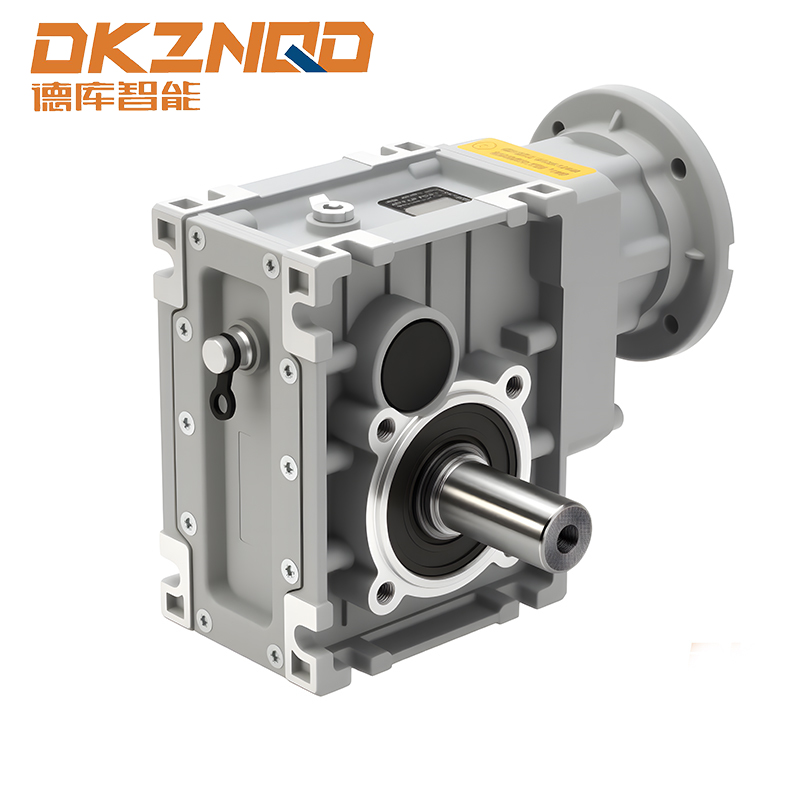 BKM Hypoid Reducer for Compact and Efficient DrivesThis reducer combines hypoid gear efficiency with right-angle geometry, offering lower backlash and quiet operation for moderate-torque machinery at a lower total cost.View Product →
Selection Checklist for Industrial Buyers
Regardless of which gearbox technology you choose, a disciplined selection process protects your machinery. Use the checklist below to compare quotes and avoid common mistakes.
- Verify the output torque at your input speed, not just the ratio.
- Check the backlash requirement for your motion profile. Servo positioning may require a low-backlash unit.
- Confirm the efficiency at the actual operating speed and load condition.
- Ask about lubrication type, oil viscosity, and the maintenance interval.
- Review the permissible radial and axial loads on the output shaft.
- Assess operating noise and temperature rise at continuous duty.
- Request a quote that includes mounting position, adapter dimensions, and motor interface.
These points apply to every gearbox. A supplier that can answer these questions clearly is more likely to deliver a reliable unit. We have written a short guide on industrial gearbox characteristics and applications that can help you evaluate new specifications.
You can read more about gear reducer maintenance to keep your equipment running safely over the long term.
FAQ: Planetary Gearbox Questions
Q1: What is the difference between a planetary gearbox and a reducer?
A planetary gearbox is a type of reducer. The term “reducer” describes any gear system that reduces speed and increases torque. A planetary reducer specifically uses the epicyclic arrangement described above.
Q2: Can a planetary gearbox replace a worm gearbox?
It can, but they are rarely interchangeable. A planetary gearbox is far more efficient and compact, but it costs more. A worm gearbox is quieter, simpler, and often provides a self-locking property. For high efficiency and precision, choose planetary; for low cost and high ratio in a single stage, worm is still practical.
Q3: How can I prevent premature tooth wear in a planetary gearbox?
Start with the right lubricant and ensure it reaches all planets. Also check that the backlash is set correctly and that the internal carrier is not distorted by the mounting flange. Regular inspection of the sun gear and planet gear teeth will reveal uneven wear early.
Final Thoughts
Planetary gearboxes are excellent for high torque density, precision, and compact coaxial drives. But they are not a universal solution. In many industrial settings, a helical, bevel, or hypoid gearmotor offers better economics or easier maintenance. The key is to match the gearbox to the actual duty rather than to the trend. If you need help with your specific torque, speed, and layout requirements, talk to a manufacturer who understands industrial gearbox design.
 05 Jun,2025