

 ENG
 English
 русский
 Español
 Türk

When your gearbox must deliver reliable torque day after day, the choice between nitriding and conventional heat treatment can decide whether a gear survives one overhaul cycle or three. The short answer is that nitriding creates a thin, exceptionally hard surface while keeping the core tough and ductile, whereas conventional heat treatment changes the entire cross-section but adds more dimensional distortion. For helical, bevel, and hypoid gears in industrial reducers, this is not a purely academic metallurgy debate. It directly affects gear accuracy, backlash, running noise, and the cost to own the drive for its full service life.
What Nitriding and Conventional Heat Treatment Actually Do
Nitriding is a thermochemical process that diffuses nitrogen into the surface of an alloy at temperatures usually between 480°C and 580°C. This forms a hard case with a typical depth of 0.2 to 0.8 mm, depending on time and material grade. Because the process temperature remains below the lower critical point of most steels, the core pressure and microstructure remain largely unchanged, which explains why nitriding produces very little distortion.
Conventional heat treatment, on the other hand, is a broad term that includes through-hardening, carburizing, and quenching and tempering. In through-hardening, the entire part is heated to a high austenitizing temperature, then quenched to transform the microstructure. This creates a uniform hardness through the cross-section, but it also introduces measurable warpage and residual stress. For gearbox seats, bearing bores, and shaft fits, controlling that distortion often requires additional grinding or hard machining after heat treatment.
So the fundamental difference is not whether the part becomes hard, but how the hardness is distributed and whether the part stays dimensionally stable.
Nitride vs Heat Treat: Quick Comparison
To make the decision more practical, here is a side-by-side comparison of the two process families. These values are typical for commercial steel gears and reducer components.
| Parameter | Nitriding | Conventional Heat Treatment |
|---|---|---|
| Process temperature | 480–580°C | 850–950°C for austenitizing |
| Typical case depth | 0.2–0.8 mm | 1.0–2.0 mm (carburized) |
| Surface hardness | 600–1200 HV | 58–62 HRC |
| Dimensional distortion | Very low | Moderate to high |
| Corrosion resistance | Improved | Generally unchanged |
| Core toughness | Preserved | Depends on tempering |
| Relative batch cost | Medium | Low to medium |
| Typical gearbox use | Precision gears, high-speed shafts | Heavy-duty low-speed stages |
Keep in mind that nitriding and heat treatment are not mutually exclusive in a reducer. Some manufacturers nitride critical gear sets after rough machining, while keeping through-hardened pinions in the low-speed stage where shock loads are higher. This integrated approach often delivers the best balance between accuracy and strength.
For a gearbox, the most meaningful trade-off is between surface hardness and dimensional stability. Nitriding wins on accuracy; conventional heat treatment wins on case depth and shock tolerance.
Performance Outcomes That Matter in a Gearbox
When you put a nitride vs heat treat question to a gearbox manufacturer, the real question is which failure mode you are trying to prevent. If the risk is galling and pitting on the tooth flank, nitriding is usually the stronger candidate. The high surface hardness reduces contact fatigue and resists the micro-welding that occurs when two metal surfaces slide under high pressure.
If the risk is root bending fatigue, through-hardening or case carburizing may be better because the hardened layer extends deeper and supports the tooth root more effectively. However, if the gear is large and thin, the distortion from conventional heat treatment can ruin the gear accuracy you paid for.
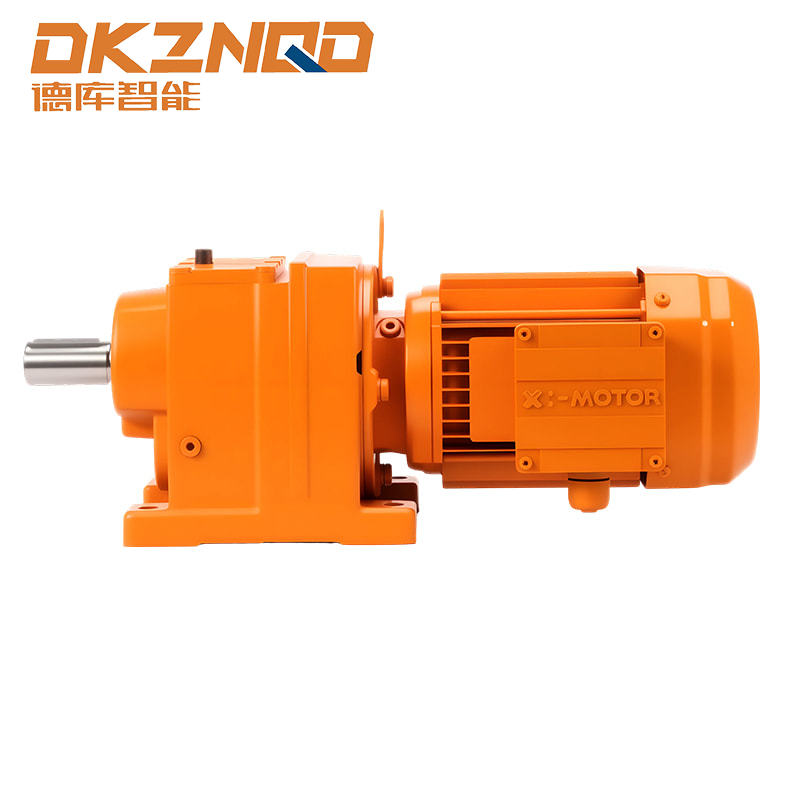
For reducers that need to hold tight backlash and produce low running noise, nitriding gives you a harder surface with less post-processing. A gas-nitrided R series helical geared motor, for example, can go through the final grinding pass with fewer corrections because the bore and shaft seats retain their original dimensions. That precision is worth paying for when your machine has strict positioning requirements.
R Series Single-stage Helical Gear Reduction Motor SuppliersSpecifications: Includes 12 different sizes of gearboxes, with 1-stage, 2-stage, and 3-stage transmissions, allowing customers to choose based on their requirements.View Product →
In angular gearbox stages, the same principle applies. The bevel gear set must maintain a precise mating pattern, and a thin, stable nitride case helps preserve that pattern over thousands of hours of operation. This is one reason why K Series helical bevel gearmotors are used in applications that demand both torque density and quiet running.
How to Choose Between Nitriding and Heat Treating for Your Gearbox
The right process depends on three practical questions: what load is the gear carrying, how tight is the dimensional tolerance, and what is your total cost of ownership?
1. Required Hardness Depth
If the gear must survive high impact loads, a deeper case is safer. Carburized and through-hardened teeth typically provide a case depth of 1–2 mm, which resists bending fatigue very well. Nitriding offers only 0.2–0.8 mm, which is sufficient for contact stress but not for repeated heavy impacts on the tooth tip.
2. Dimensional Precision
If your application demands precision classes such as DIN 6 or AGMA 12, nitriding gives you a head start because it does not move the part. However, you still need to control machining tolerances before nitriding. The nitride case is thin, so you cannot grind away large tool marks without losing hardness.
3. Cost of the Full Process
Nitriding is often described as more expensive, but that is only true if you compare the surface treatment step alone. When you add the cost of post-heat-treatment grinding, straightening, and scrap caused by distortion, nitriding can become very competitive. For a K Series helical bevel gearmotor that ships as a compact unit, lower distortion means fewer rework costs and faster assembly.
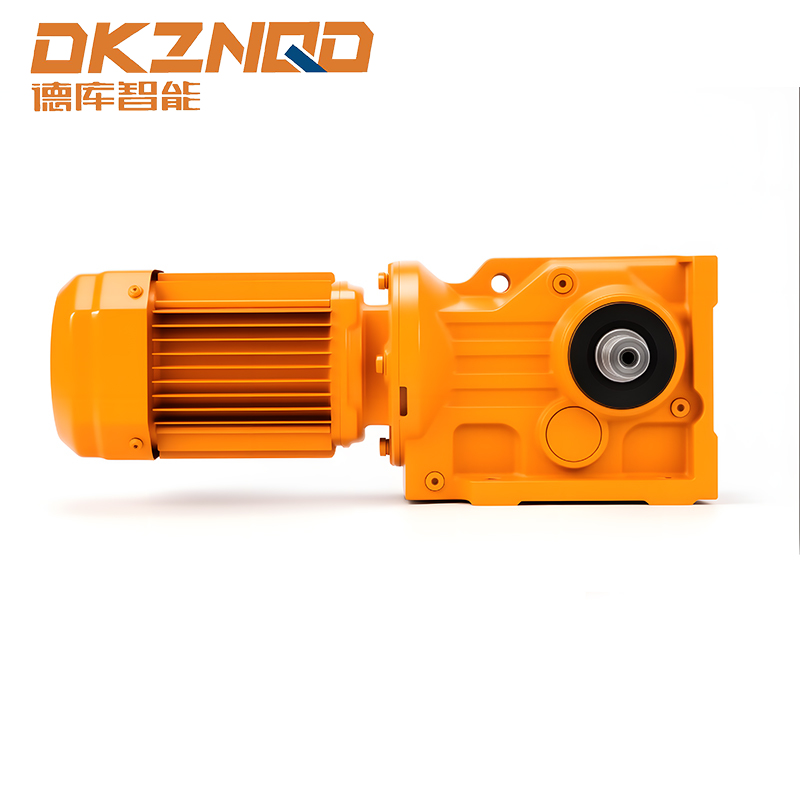 K Series Helical Bevel Gear Motor SuppliersSpecifications: Includes 12 gearbox sizes, allowing customers to select according to their application requirements.View Product →
Material Compatibility and Case Depth: What Looks Good on Paper May Not Work in Practice
Nitriding works best on steels that contain nitride-forming elements such as aluminum, chromium, molybdenum, and vanadium. Common grades include 38CrMoAl, 40Cr, and 42CrMo. If you try to nitride a low-alloy carbon steel that lacks these elements, the case will be thinner and less repeatable. This is a key point to check when comparing suppliers.
Conventional heat treatment is much more forgiving in material terms. Most carbon and alloy steels can be quenched and tempered to a wide range of hardness levels. For hypoid gear sets, the quench distortion can be corrected by hard machining, but that adds cost and lead time.
In a well-designed reducer, the material and the process must be matched. For a BKM hypoid gear reducer, the low backlash and compact design depend on maintaining tight tolerances in both the gear and the housing. That makes the low-distortion nitriding route attractive for the gear set, while the input pinion may be carburized for maximum toughness.
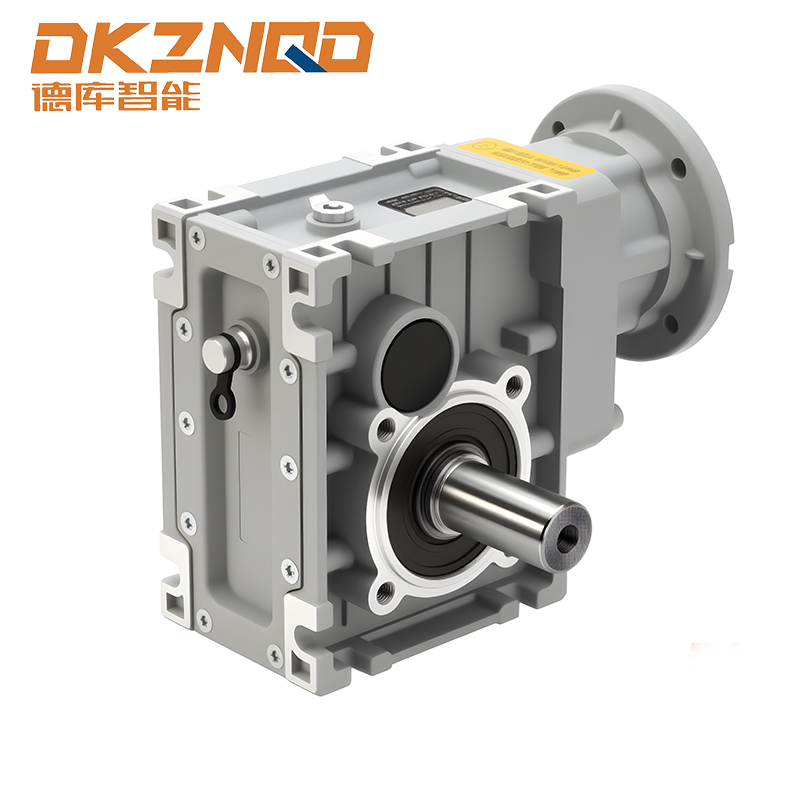 BKM High-efficiency Hypoid Reducer SuppliersSpecifications: Includes 5 types of gear reducers with 2-stage and 3-stage transmissions, selectable according to customer requirements.View Product →
This dual approach is why many premium gearbox makers do not advertise a single treatment. They specify the treatment at each stage based on the load and the accuracy class. As a buyer, you should ask your supplier which process they use on the low-speed stage versus the high-speed stage, because that tells you how they manage the trade-off between distortion and case depth.
Practical Impact on Gearbox Life and Service
Once the gearbox is running, the surface treatment affects maintenance intervals and repair costs. A nitrided gear that resists pitting will usually maintain its tooth profile longer, which translates into lower vibration and quieter running. A through-hardened gear may tolerate a foreign particle better, but if it starts to wear, the wear pattern is often deeper and harder to correct.
One subtle but important factor is gearbox accuracy. If the housing bore and shaft seats have moved during heat treatment, the reducer may not meet its stated runout specification. Re-shimming or re-grinding after installation is expensive and often impossible on site. This is why precision-conscious engineering teams ask for the heat treatment method before they place an order.
In service, if a nitrided gear is damaged, repair is usually limited to replacing the component. You cannot weld or machine the hardened case without losing its performance. With through-hardened gears, you may be able to re-machine and re-treat a small area, but the risk of new distortion remains. For high-volume production lines, the simpler decision is often to use a nitrided gear pair that is ordered with the correct hardness from the start.
One way to prevent early reducer failure is to follow a planned maintenance schedule. Check the oil condition, examine the gear surface for polishing or pitting, and verify backlash at each service interval. This is especially important when the reducer uses precision-hardened gears that are not meant to be re-ground.
Frequently Asked Questions
Q1: Is nitride a heat treatment?
Yes, nitriding is a specific type of thermochemical heat treatment. It is a surface treatment that changes the chemistry of the metal surface, rather than the core. That distinction matters when someone compares “nitride vs heat treat” because the two terms do not refer to the same class of operation.
Q2: Which is better, nitriding or carburizing?
It depends on the load case. Carburizing gives a deeper case and better impact resistance for heavy-duty gear stages. Nitriding gives a harder surface with lower distortion and better corrosion resistance, making it ideal for precision gears that are not subjected to severe shock loads.
Q3: Does nitriding change the dimensions of a part?
The part does not go through a high-temperature phase transformation, so dimensional change is very small. There is a slight growth of the surface because nitrogen atoms occupy space in the lattice, but this is on the order of a few micrometers and is usually predictable.
Q4: Which metals can be nitrided?
Alloy steels containing chromium, molybdenum, vanadium, or aluminum are the best candidates. Stainless steels can also be nitrided, but the oxide layer must be removed first. Plain carbon steels are not recommended because they do not form a stable nitride case.
Q5: How does the choice influence gear reducer selection?
If you need compact, quiet, high-precision reducers, nitrided gear sets are often the safer choice. If your reducer is exposed to heavy shock loads or requires re-machining after treatment, carburized or through-hardened gears may be more practical. Ask your supplier about the treatment used on each gear stage before you finalize the specification.
 05 Jun,2025