

 ENG
ENG
 English
 русский
 Español
 Türk
Türk

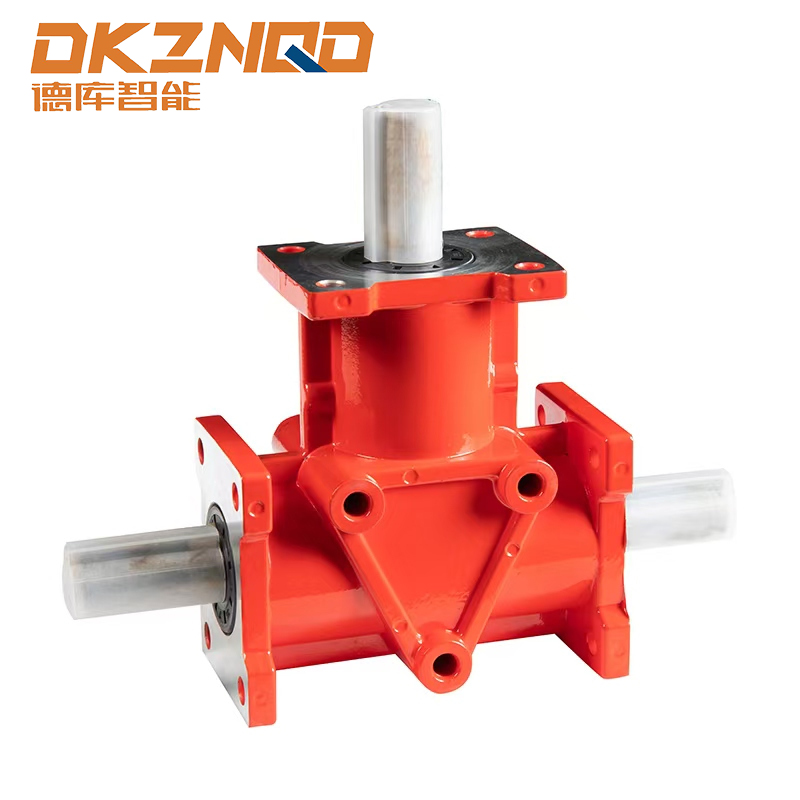
When selecting a bevel gearbox for an industrial application, one of the most fundamental decisions engineers face is choosing between a straight bevel gearbox and a spiral bevel gearbox. Although both types transmit power between intersecting shafts — typically at a 90-degree angle — their internal tooth geometry leads to dramatically different performance characteristics. Understanding these differences is essential for making the right choice in terms of noise, efficiency, load capacity, speed range, and long-term reliability.
This article breaks down the core distinctions between the two types, compares their performance across key metrics, and helps you identify which design is best suited for your specific application requirements.
What Is a Straight Bevel Gearbox?
A straight bevel gearbox uses bevel gears whose teeth are cut in a straight line, radiating outward from the apex of the cone-shaped gear body. The teeth of the mating gears engage along the full tooth face simultaneously, meaning contact is made and broken abruptly with each tooth cycle.
This tooth geometry makes straight bevel gears relatively straightforward to manufacture and inspect, which historically made them a common choice for lower-speed, lower-load applications. Key characteristics include:
- Teeth aligned radially with no helix or curvature angle
- Full-face contact engagement per tooth cycle
- Simpler manufacturing process, lower tooling complexity
- Generates higher impact and vibration during meshing
- Typically limited to pitch line velocities below 5 m/s
Due to their abrupt tooth engagement, straight bevel gears produce more noise and vibration compared to spiral variants. They are generally best suited for slow-speed, light-to-moderate torque applications where precision and quiet operation are not primary requirements.
What Is a Spiral Bevel Gearbox?
A spiral bevel gearbox uses bevel gears with curved, oblique teeth that are cut along a spiral angle — typically between 25 and 45 degrees — on the cone surface. Unlike straight bevel gears, the teeth of a spiral bevel gear engage gradually, with multiple teeth in contact at any given moment. This progressive contact results in smoother, quieter, and more efficient power transmission.
Spiral bevel gears are the preferred choice in modern high-performance and precision-demanding applications. Their defining characteristics include:
- Curved teeth with a defined spiral angle for gradual engagement
- Higher contact ratio — multiple teeth share the load simultaneously
- Significantly lower noise and vibration levels during operation
- Capable of operating at pitch line velocities exceeding 40 m/s
- Higher torque density and load-carrying capacity per unit size
- More complex manufacturing requiring specialized grinding and lapping equipment
The spiral tooth geometry introduces an axial thrust force component that must be accommodated by appropriate bearing selection, but this is a manageable engineering consideration that is far outweighed by the performance gains in most applications.
Tooth Geometry: The Root of Every Difference
The most important distinction between these two gearbox types lies entirely in their tooth geometry. This single design variable cascades into differences in noise, load capacity, speed capability, and application fit.
Contact Pattern and Contact Ratio
In a straight bevel gear, the contact ratio — which describes how many teeth are simultaneously engaged — is typically between 1.0 and 1.2. This means that at any moment, roughly one tooth is carrying the full load. When one tooth disengages before the next fully engages, there is a brief impact that produces noise and stress concentration.
In a spiral bevel gear, the overlap ratio (axial contact ratio) is added on top of the transverse contact ratio, bringing the total contact ratio to values typically between 1.5 and 2.5 or higher. With more teeth sharing the load simultaneously, each individual tooth experiences lower stress, the load transition is smooth, and the system operates with far less vibration.
Axial Thrust Forces
Straight bevel gears generate only radial and tangential force components. Spiral bevel gears, by contrast, also generate axial thrust forces due to the helix angle of their teeth. The direction of axial thrust depends on the hand of the spiral (left-hand or right-hand) and the direction of rotation. Engineers must account for this when selecting bearings — typically tapered roller bearings or angular contact bearings — to handle the combined radial and axial loads effectively.
Side-by-Side Performance Comparison
The table below summarizes the key performance differences between straight bevel and spiral bevel gearboxes across the most critical engineering parameters:
| Parameter | Straight Bevel Gearbox | Spiral Bevel Gearbox |
| Tooth Form | Straight, radial | Curved, spiral angle 25-45 deg |
| Contact Ratio | 1.0 - 1.2 | 1.5 - 2.5+ |
| Noise Level | High (especially at speed) | Low to very low |
| Max Pitch Line Velocity | Up to 5 m/s | Up to 40+ m/s |
| Load Capacity | Moderate | High |
| Torque Density | Lower | Higher |
| Axial Thrust Force | None | Present (both directions) |
| Manufacturing Complexity | Low | High |
| Unit Cost | Lower | Higher |
| Typical Efficiency | 96 - 98% | 98 - 99.5% |
| Reversal Operation | Suitable | Requires careful bearing design |
| Best Application Fit | Low-speed, low-load, simple drives | High-speed, high-load, precision drives |
Noise and Vibration: A Critical Differentiator
For many modern industrial environments, noise and vibration are not just comfort considerations — they are engineering requirements. Excessive vibration can damage connected components, reduce bearing life, cause fatigue in structural mounts, and introduce positioning errors in precision systems.
Straight bevel gears, due to their abrupt full-face tooth engagement, are inherently noisy at elevated speeds. As rotational speed increases, the impact frequency rises proportionally, and the noise level can become significant. This limits their practical use to applications where low speeds make this a non-issue.
Spiral bevel gears, by contrast, engage progressively. The gradual tooth contact means there is no sudden impact load, and the overlapping contact ensures continuous, smooth force transfer. In well-manufactured spiral bevel gearboxes, noise levels can be reduced by 10 to 15 dB compared to equivalent straight bevel designs operating at the same speed and load. This difference is clearly perceptible — roughly equivalent to the difference between a quiet office and a normal conversation level.
For applications in food processing, medical equipment, precision automation, or aerospace ground support, this noise and vibration advantage of spiral bevel gearboxes is often the deciding selection factor.
Load Capacity and Torque Density
Because spiral bevel gears distribute the transmitted force across multiple teeth simultaneously, each tooth is subjected to a lower peak stress. This has two important practical consequences:
- A spiral bevel gearbox of a given physical size can handle significantly higher torque than a straight bevel gearbox of equivalent size.
- For a given torque requirement, a spiral bevel gearbox can be designed in a smaller, lighter package — an important advantage in mobile equipment, aerospace, and robotics.
In practice, the torque capacity advantage of spiral bevel gears over straight bevel gears of the same module and face width is typically in the range of 20% to 35%, depending on specific tooth geometry parameters. When weight and space are at a premium, this advantage makes spiral bevel gearboxes the clear engineering choice.
Material selection also plays a role — both gear types are typically manufactured from case-hardened alloy steels, but the higher tooth strength utilization in spiral bevel gears justifies the investment in precision grinding and surface finishing processes that further enhance their load capacity.
Speed Range and Efficiency
Speed capability is one of the clearest dividing lines between these two gearbox types:
- Straight bevel gearboxes are generally limited to pitch line velocities below 5 m/s. Beyond this, the impact-induced vibration and noise become prohibitive, and tooth wear accelerates rapidly.
- Spiral bevel gearboxes can operate reliably at pitch line velocities of 40 m/s and above, with carefully designed and ground gears achieving even higher limits in aerospace and precision machine tool applications.
In terms of mechanical efficiency, both types perform well, but spiral bevel gearboxes typically achieve 98% to 99.5% efficiency per gear stage due to the lower sliding losses enabled by optimized tooth geometry. Straight bevel gearboxes typically fall in the 96% to 98% range. While this difference may seem small, it becomes significant in high-power or continuous-duty applications where energy costs are a key operating expense.
Manufacturing, Cost, and Maintenance Considerations
Manufacturing Complexity
Straight bevel gears can be produced on conventional gear cutting machines using relatively simple tooling. The manufacturing process is well-established and does not require specialized equipment. Inspection is also straightforward since tooth geometry can be verified with standard metrology tools.
Spiral bevel gears require specialized machine tools — historically face-milling or face-hobbing machines — and the tooth flanks must be precision-ground and often lapped in matched pairs to achieve the required contact pattern and surface finish. This process requires more time, skilled operators, and sophisticated quality control procedures, all of which contribute to a higher unit cost.
Cost Comparison
As a general guideline, a spiral bevel gearbox will typically cost 30% to 60% more than a comparable straight bevel gearbox, depending on size, precision class, and material requirements. However, when evaluated on a total cost of ownership basis — including energy savings, longer service life, reduced maintenance, and avoided downtime — the spiral bevel gearbox frequently proves more economical over the equipment's operating life.
Maintenance and Service Life
Because spiral bevel gears distribute contact stress more evenly, they experience lower peak Hertzian contact pressure, which translates to reduced pitting and fatigue wear over time. Properly lubricated and maintained spiral bevel gearboxes routinely achieve service lives of 20,000 to 50,000 hours or more in continuous industrial service. Straight bevel gearboxes, operating within their appropriate speed and load limits, also provide reliable service but may require more frequent tooth inspection in applications with shock loads or reversals.
Typical Application Scenarios for Each Type
Where Straight Bevel Gearboxes Are Commonly Used
Straight bevel gearboxes remain in use across a range of low-speed, moderate-load applications where their lower cost and simpler construction are advantages:
- Agricultural machinery (hand-operated or slow-power drives)
- Simple hand tools and manual transmission mechanisms
- Low-speed conveyor direction changes
- Quarrying and heavy-duty slow drives where noise is not a constraint
- Older industrial equipment and legacy machine replacements
Where Spiral Bevel Gearboxes Excel
Spiral bevel gearboxes dominate in any application requiring high speed, high torque, low noise, or compact design:
- Automotive rear axles and differentials — the automotive industry adopted spiral bevel gears almost universally for their noise and efficiency advantages
- Industrial robot joints — high torque density in compact packages is essential for articulated arm robots
- CNC machine tool spindle drives — quiet, precise, and capable of high-speed operation
- Marine propulsion systems — reliability and efficiency under continuous heavy-duty operation
- Aerospace ground support and auxiliary drives — where weight, space, and noise requirements are demanding
- Food and beverage processing machinery — hygienic, quiet operation with long service intervals
- Wind turbine pitch and yaw drives — fatigue life and reliability under variable loading
- Printing and packaging machinery — precision positioning and smooth torque delivery
How to Choose Between the Two: A Decision Framework
When making a selection between a straight bevel and a spiral bevel gearbox, consider the following decision factors in order of priority:
- Operating Speed: If pitch line velocity exceeds 5 m/s, spiral bevel is the only viable choice.
- Noise and Vibration Requirements: If the application has noise limits or vibration-sensitive connected equipment, choose spiral bevel.
- Torque and Power Density: If maximum torque in minimum space is required, spiral bevel gearboxes offer significantly better torque density.
- Budget Constraints: If the application is low-speed and cost is the primary driver, a straight bevel gearbox may be appropriate.
- Service Life and Reliability: For continuous-duty, high-cycle applications, the longer service life of spiral bevel gearboxes typically justifies their higher initial cost.
- Reversal Loads: Both types handle reversals, but spiral bevel bearing systems must be specifically designed to manage axial thrust in both directions.
In the vast majority of modern industrial design scenarios, where performance, efficiency, and service life are evaluated together, the spiral bevel gearbox is the preferred solution. The straight bevel gearbox retains relevance primarily in cost-sensitive, low-speed legacy applications.
Frequently Asked Questions
Q1: Can a spiral bevel gearbox replace a straight bevel gearbox directly?
In most cases, yes — provided the mounting envelope and shaft dimensions are compatible. A spiral bevel gearbox will perform as well or better in virtually every operating condition, though it will require appropriate bearing support for axial thrust loads.
Q2: Are spiral bevel gearboxes significantly louder in reverse than forward operation?
No. Spiral bevel gearboxes operate quietly in both directions. However, the axial thrust reverses direction when rotation reverses, so the bearing system must be designed to handle thrust loads in both axial directions.
Q3: What lubrication is recommended for spiral bevel gearboxes?
Gear oils with EP (extreme pressure) additives are typically specified, with viscosity selected based on operating speed and temperature. Many manufacturers recommend ISO VG 220 or VG 320 gear oils for standard industrial applications.
Q4: What is the typical gear ratio range for bevel gearboxes?
Single-stage bevel gearboxes — both straight and spiral — typically achieve gear ratios between 1:1 and 5:1. Ratios beyond this range normally require multi-stage or combined gearbox arrangements.
Q5: Do spiral bevel gears need to be replaced as matched pairs?
Yes. Spiral bevel gears are lapped and matched in pairs during manufacturing to optimize their contact pattern. Replacing only one gear of a worn pair will result in poor contact, increased noise, and accelerated wear on the new gear.
Q6: How does operating temperature affect the choice between the two types?
Both types are affected by temperature through lubrication viscosity changes. Spiral bevel gearboxes, with their higher efficiency, generate less heat internally, which is an advantage in thermally constrained installations or continuously running systems.
 05 Jun,2025