

 ENG
ENG
 English
 русский
 Español
 Türk
Türk

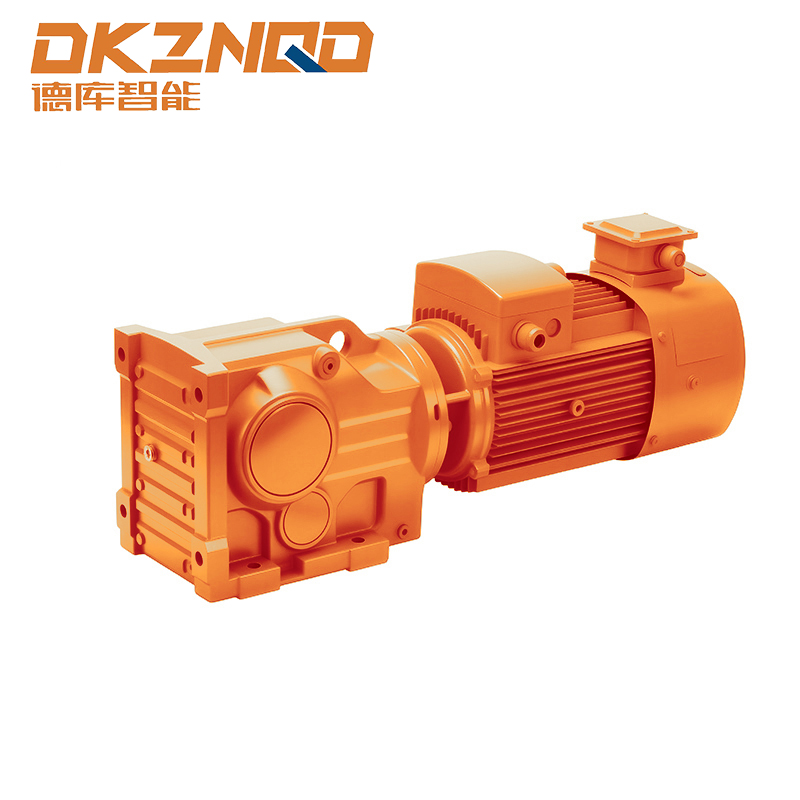
Fundamental Working Principles of K Series Helical Bevel Gearmotors and Worm Gearboxes
The efficiency rating of industrial gear transmission equipment directly determines energy consumption, operational costs, and long-term service life in industrial automation systems. Among the most widely used gear devices, K Series Helical Bevel Gearmotor and worm gearboxes represent two distinct technical routes, with their efficiency performance forming the core difference for B2B industrial buyers to make purchasing decisions. To fully understand their efficiency gaps, it is essential to start with their basic working principles and internal structural designs, as these factors are the root causes of efficiency differences.
The K Series Helical Bevel Gearmotor is a precision transmission device that integrates helical gears and bevel gears. Its transmission structure adopts a right-angle design, combining the smooth meshing characteristics of helical gears and the right-angle power transmission advantages of bevel gears. The gear teeth are processed through precision grinding and hardening treatment, forming a continuous and stable meshing state during operation. Power is transmitted through multiple gear pairs in sequence, with minimal sliding friction between gear teeth, which lays a solid foundation for high-efficiency operation.
In contrast, the worm gearbox relies on the meshing of a worm and a worm wheel to achieve power transmission. The worm is typically a driving part with a spiral structure, and the worm wheel is a driven part similar to a helical gear. This structure can achieve a large single-stage reduction ratio and has self-locking characteristics under specific conditions. However, the transmission method is dominated by sliding friction between the worm and the worm wheel, which is an inherent factor leading to lower efficiency compared to gear-based transmission equipment.
Structural Composition of K Series Helical Bevel Gearmotors
The core components of K Series Helical Bevel Gearmotors include precision-machined helical gear sets, spiral bevel gear sets, high-strength shafts, sealed housings, and high-performance bearings. The helical gears adopt an inclined tooth design, which enables more teeth to mesh at the same time during operation, reducing impact and noise. The bevel gears are distributed at a 90-degree angle, realizing right-angle power transmission without additional conversion components.
All gear components are made of high-quality alloy steel, through carburizing, quenching, and grinding processes, ensuring high surface hardness and precise tooth profiles. The matching clearance between gears is controlled within an extremely small range, which not only improves transmission accuracy but also reduces energy loss caused by tooth surface friction. The integrated design of the motor and gearbox eliminates the power loss caused by independent connection components, further optimizing the overall operational efficiency.
Structural Composition of Worm Gearboxes
The worm gearbox is mainly composed of a worm, a worm wheel, a box body, bearings, and sealing parts. The worm is usually made of hardened steel, and the worm wheel is made of wear-resistant bronze alloy materials to reduce friction and wear. The single-stage transmission structure is simple, and the right-angle transmission can be realized directly, which is suitable for occasions with limited installation space and low-speed and high-torque requirements.
Due to the sliding friction between the worm and the worm wheel during transmission, the material matching and lubrication conditions have a crucial impact on efficiency. Even with optimized materials and lubricants, the sliding friction cannot be completely eliminated, which is an unavoidable structural defect of worm gearboxes and directly limits their upper efficiency limit.
Core Efficiency Rating Data of K Series Helical Bevel Gearmotors
Efficiency rating is the key indicator to measure the energy conversion capacity of gearmotors, referring to the ratio of output power to input power under rated operating conditions. The K Series Helical Bevel Gearmotor, with its optimized gear structure and precision manufacturing process, achieves industry-leading efficiency performance, which is the primary reason why it is favored in high-efficiency demand industrial scenarios.
Under rated load and standard operating conditions, the comprehensive efficiency of K Series Helical Bevel Gearmotor can reach 94% to 96%, which is the highest level in right-angle transmission gear equipment. This efficiency data is not affected by the reduction ratio in a wide range, maintaining stable performance from small reduction ratios to large reduction ratios.
Efficiency Performance Under Different Load Conditions
The efficiency stability of K Series Helical Bevel Gearmotors under variable load conditions is one of its core advantages. In industrial applications, equipment often operates under no-load, light-load, rated load, and overload conditions, and the efficiency change range directly affects the actual energy-saving effect.
- Under 100% rated load: the efficiency is maintained at 94% - 96%, reaching the optimal operating state
- Under 75% rated load: the efficiency is 93% - 95%, with almost no attenuation
- Under 50% rated load: the efficiency is 92% - 94%, still maintaining a high level
- Under 25% rated load: the efficiency is 90% - 92%, the attenuation range is far lower than similar products
This stable efficiency performance ensures that the K Series Helical Bevel Gearmotor can maintain low energy consumption in long-term intermittent operation or continuous variable load operation, greatly reducing the operating cost of industrial equipment.
Efficiency Changes with Different Reduction Ratios
The K Series Helical Bevel Gearmotor adopts a multi-stage gear transmission design, and the efficiency changes very little with the increase of the reduction ratio. For single-stage reduction models, the efficiency can reach 95% - 96%; for two-stage reduction models, the efficiency is 94% - 95%; for three-stage reduction models, the efficiency is still as high as 93% - 94%.
Even in the application scenarios of large reduction ratios, the efficiency loss of each additional stage of gears is controlled below 1%, which is an irreplaceable advantage of worm gearboxes. This characteristic makes the K Series Helical Bevel Gearmotor suitable for high-precision transmission occasions with both large reduction ratios and high-efficiency requirements.
Influence of Operating Environment on Efficiency
The K Series Helical Bevel Gearmotor has strong adaptability to the operating environment. In the ambient temperature range of -20°C to 40°C, its efficiency remains basically unchanged. The fully enclosed lubrication system ensures that the gears are in a good lubrication state for a long time, reducing friction loss and maintaining stable efficiency performance.
After 10,000 hours of continuous operation test, the efficiency attenuation of the K Series Helical Bevel Gearmotor is less than 1%, which means that it can maintain high-efficiency operation throughout the entire service life, without a significant decline in efficiency due to long-term use.
Core Efficiency Rating Data of Worm Gearboxes
As a traditional right-angle transmission device, worm gearboxes have the advantages of simple structure, low cost, and self-locking function, but their efficiency performance is significantly lower than that of K Series Helical Bevel Gearmotors. The efficiency of worm gearboxes is greatly affected by structural characteristics, reduction ratio, and load conditions, with a large attenuation range and low overall level.
Under rated load conditions, the highest efficiency of standard worm gearboxes is only 70% - 85%, which is 10 to 25 percentage points lower than that of K Series Helical Bevel Gearmotors. This efficiency gap directly leads to higher energy consumption and more heat generation during operation, limiting its application in high-efficiency and long-term continuous operation scenarios.
Efficiency Performance Under Different Load Conditions
The efficiency of worm gearboxes is extremely sensitive to load changes, and the efficiency attenuation is very obvious under light load conditions, which is a major disadvantage compared with gearmotors.
- Under 100% rated load: the efficiency is 70% - 85%, reaching the maximum efficiency value
- Under 75% rated load: the efficiency drops to 65% - 80%
- Under 50% rated load: the efficiency is 55% - 70%, with a significant decline
- Under 25% rated load: the efficiency is only 40% - 55%, the loss is extremely large
In the light load state, most of the input energy of the worm gearbox is converted into heat energy due to sliding friction, resulting in serious energy waste. This characteristic makes it unsuitable for equipment that operates under light load for a long time.
Efficiency Changes with Different Reduction Ratios
The efficiency of worm gearboxes has a strong negative correlation with the reduction ratio, and the efficiency decreases sharply with the increase of the reduction ratio, which is a fatal flaw in the application of large reduction ratios.
- Single-stage reduction ratio 10:1: efficiency is 80% - 85%
- Single-stage reduction ratio 30:1: efficiency drops to 70% - 75%
- Single-stage reduction ratio 50:1: efficiency is only 60% - 65%
- Double-stage reduction ratio above 100:1: efficiency is lower than 50%
The larger the reduction ratio, the greater the sliding friction between the worm and the worm wheel, and the more serious the energy loss. In industrial scenarios requiring large reduction ratios, the use of worm gearboxes will lead to a substantial increase in energy costs.
Self-locking Function and Efficiency Trade-off
Part of the worm gearboxes have a self-locking function, which can prevent the load from reversing when the motor stops, and is suitable for lifting and inclined transmission equipment. However, the self-locking function is accompanied by extremely low efficiency, and the efficiency of self-locking worm gearboxes is only 30% - 50% under any working condition.
This trade-off between function and efficiency makes the self-locking worm gearbox only applicable to special scenarios with low efficiency requirements and high safety requirements, and cannot meet the needs of energy-saving industrial production.
Comparative Analysis of Efficiency Ratings Between K Series Helical Bevel Gearmotors and Worm Gearboxes
Through the independent analysis of the efficiency data of the two types of gear transmission equipment, the core gap in their efficiency performance can be clearly defined. For B2B industrial buyers, this comparative data is the key basis for selecting equipment that matches production needs and controlling operational costs. The following will conduct a comprehensive comparison from multiple dimensions such as rated efficiency, load adaptability, reduction ratio influence, and long-term operation stability.
Comprehensive Efficiency Data Comparison Table
| Comparison Items | K Series Helical Bevel Gearmotor | Worm Gearbox |
| Rated Load Efficiency | 94% - 96% | 70% - 85% |
| Light Load (25%) Efficiency | 90% - 92% | 40% - 55% |
| Large Reduction Ratio Efficiency | 93% - 94% | Below 50% |
| Long-term Operation Attenuation | Less than 1% | 5% - 10% |
| Energy Conversion Efficiency | High, minimal heat generation | Low, large heat generation |
The data in the table clearly shows that the K Series Helical Bevel Gearmotor has absolute advantages in all efficiency indicators, with an overall efficiency 20% - 30% higher than that of worm gearboxes on average. This efficiency gap will be amplified into huge cost differences in long-term industrial production.
Energy Consumption Comparison in Actual Industrial Applications
Taking a 5.5KW industrial transmission system as an example, operating 8 hours a day and 300 days a year, the annual energy consumption difference between the two devices is calculated based on the average efficiency:
The annual power consumption of K Series Helical Bevel Gearmotor: 5.5KW × 8h × 300d ÷ 0.95 ≈ 13895 kWh
The annual power consumption of worm gearbox: 5.5KW × 8h × 300d ÷ 0.75 ≈ 17600 kWh
The annual power consumption difference between the two is 3705 kWh. For large-scale industrial enterprises equipped with hundreds of transmission devices, the annual energy cost saved by using K Series Helical Bevel Gearmotors is very considerable, which can quickly offset the initial purchase cost difference.
Heat Generation and Operational Stability Comparison
Efficiency is directly related to heat generation during operation. The low efficiency of worm gearboxes means that more electrical energy is converted into heat energy, which will lead to a continuous rise in equipment temperature. Under continuous operation, the surface temperature of worm gearboxes can reach 60°C - 80°C, and the internal lubricating oil is prone to aging and failure, increasing the risk of component wear and failure.
The K Series Helical Bevel Gearmotor has high energy conversion efficiency, less heat generation, and the operating temperature is controlled at 30°C - 45°C for a long time. The low-temperature operating state not only protects the lubricating oil and internal components but also improves the operational stability and service life of the equipment, reducing the frequency of maintenance and replacement.
Factors Affecting the Efficiency Difference Between the Two Gear Devices
The significant efficiency gap between K Series Helical Bevel Gearmotors and worm gearboxes is not accidental, but determined by a variety of inherent factors, including transmission mode, gear meshing form, manufacturing process, material selection, and lubrication design. Understanding these influencing factors can help industrial buyers deeply grasp the essential difference between the two devices and make more scientific purchasing decisions.
Transmission Mode and Friction Form
The K Series Helical Bevel Gearmotor adopts rolling friction transmission. The helical gears and bevel gears are in continuous rolling contact during meshing, the friction coefficient is extremely low, and the energy loss caused by friction is minimal. Rolling friction is the most efficient transmission mode in mechanical gear devices, which is the core reason for the high efficiency of gearmotors.
The worm gearbox adopts sliding friction transmission. The worm and the worm wheel slide relative to each other during meshing, the friction coefficient is large, and a lot of energy is consumed in the form of heat. Sliding friction is inherently inefficient, which is the fundamental factor limiting the efficiency of worm gearboxes and cannot be completely improved through structural or material optimization.
Manufacturing Precision and Assembly Quality
K Series Helical Bevel Gearmotor adopts precision CNC grinding processing, the gear tooth profile accuracy reaches grade 5-6, the assembly clearance is strictly controlled, and the gear meshing is more sufficient. High manufacturing precision ensures that each gear can play the optimal transmission effect, reducing additional power loss caused by poor meshing.
The manufacturing precision of worm gearboxes is relatively low, the tooth profile processing accuracy is grade 7-8, and the assembly clearance is large. The insufficient meshing between the worm and the worm wheel will further increase friction loss and reduce the actual operating efficiency. The difference in manufacturing precision directly enlarges the efficiency gap between the two devices.
Material Selection and Surface Treatment
The gear materials of K Series Helical Bevel Gearmotors are high-strength alloy steel, with carburizing and quenching surface treatment, surface hardness above HRC58-62, with high wear resistance and low friction coefficient. The optimized material matching reduces the friction loss between gear teeth and maintains stable efficiency for a long time.
The worm wheel of the worm gearbox is made of bronze alloy, which has good wear resistance but a relatively high friction coefficient. Even with the best material matching, the sliding friction between steel and bronze is much higher than the rolling friction between alloy steel gears, which cannot change the low-efficiency characteristics.
Lubrication System Design
The K Series Helical Bevel Gearmotor is equipped with a professional lubrication system, which can form a uniform and stable oil film on the gear surface, separating the gear teeth and reducing direct friction. The fully enclosed design prevents lubricating oil pollution and ensures the long-term effectiveness of the lubrication effect.
The lubrication effect of worm gearboxes is easily affected by sliding friction. The high heat generated during operation will accelerate the thinning and failure of lubricating oil, making it impossible to form a complete oil film. The deterioration of lubrication conditions will further reduce efficiency and form a vicious circle.
Selection Guidance for B2B Industrial Buyers Based on Efficiency Requirements
For B2B industrial buyers, the selection between K Series Helical Bevel Gearmotors and worm gearboxes should be based on the actual working conditions, efficiency requirements, and cost budget of the equipment. 20% of the decision-making focus should be on the matching of equipment performance and production needs, and 80% should focus on the product's own efficiency, service life, and long-term operating costs. The following provides targeted selection guidance for different application scenarios.
Scenarios Suitable for K Series Helical Bevel Gearmotors
The K Series Helical Bevel Gearmotor is the first choice for industrial scenarios requiring high efficiency, energy saving, and long-term stable operation, and is widely used in various automated production lines, packaging machinery, food processing equipment, logistics transportation systems, etc.
- Continuous operation scenarios: equipment that runs 24 hours a day, high efficiency can greatly reduce energy consumption
- Variable load operation scenarios: stable efficiency under light load and heavy load, no large attenuation
- Large reduction ratio requirements: maintain high efficiency under large reduction ratios, no significant loss
- Energy-saving priority projects: national energy-saving and emission-reduction industrial transformation projects
- High-precision transmission occasions: automated production lines with strict requirements for transmission accuracy
In these scenarios, the high-efficiency advantage of the K Series Helical Bevel Gearmotor can be fully utilized, and the saved energy costs can offset the higher initial investment within 1-2 years, with higher cost-effectiveness in the long run.
Scenarios Suitable for Worm Gearboxes
Worm gearboxes are only suitable for specific scenarios with low efficiency requirements, self-locking needs, or limited budget, and are not recommended for long-term continuous operation equipment.
- Intermittent operation scenarios: equipment that runs for a short time and has a long standby time
- Scenarios requiring self-locking: lifting machinery, inclined conveyor belts, etc.
- Low-power small equipment: household small machinery, experimental equipment with low power
- Temporary use equipment: temporary construction machinery, short-term test devices
In these scenarios, the low cost and self-locking function of worm gearboxes are the main selection factors, and the low efficiency disadvantage has little impact on the overall production cost.
Long-term Cost-benefit Analysis for Buyers
When purchasing industrial gear transmission equipment, B2B buyers should not only focus on the initial purchase price but also conduct a full-life cycle cost analysis. The full-life cycle includes purchase cost, energy cost, maintenance cost, and replacement cost.
The purchase price of K Series Helical Bevel Gearmotors is 30%-50% higher than that of worm gearboxes, but the annual energy cost is 20%-30% lower, the maintenance cost is 50% lower, and the service life is twice as long. For industrial equipment with a service life of more than 5 years, the total cost of using K Series Helical Bevel Gearmotors is 20% - 40% lower than that of worm gearboxes, with obvious economic benefits.
FAQ About Efficiency Ratings of K Series Helical Bevel Gearmotors and Worm Gearboxes
Q1: What is the maximum efficiency difference between K Series Helical Bevel Gearmotor and worm gearbox?
The maximum efficiency difference can reach 50%, especially under light load and large reduction ratio conditions.
Q2: Will the efficiency of K Series Helical Bevel Gearmotor decrease significantly after long-term use?
No, the efficiency attenuation is less than 1% after 10,000 hours of continuous operation, with extremely high stability.
Q3: Can worm gearboxes achieve the same efficiency as K Series Helical Bevel Gearmotors through optimization?
No, sliding friction is an inherent structural defect, and efficiency cannot be improved to the level of gear transmission.
Q4: Is the high efficiency of K Series Helical Bevel Gearmotor suitable for all industrial scenarios?
It is suitable for most continuous and variable load scenarios, and is the best choice for energy-saving industrial production.
Q5: How much energy can be saved annually by replacing a worm gearbox with a K Series Helical Bevel Gearmotor?
Taking 5.5KW equipment as an example, the annual power saving is about 3705 kWh, and the larger the power, the more obvious the energy saving effect.
Q6: Does the K Series Helical Bevel Gearmotor have right-angle transmission function like a worm gearbox?
Yes, it adopts a right-angle design, which can realize 90-degree power transmission while maintaining high efficiency.
Q7: What is the impact of efficiency on the service life of gear equipment?
High efficiency means less heat generation and less wear, and the service life of K Series Helical Bevel Gearmotor is twice that of worm gearboxes.
Q8: Is the lubrication maintenance frequency of K Series Helical Bevel Gearmotor higher than that of worm gearboxes?
No, the fully enclosed design reduces the maintenance frequency, and the maintenance cost is lower than that of worm gearboxes.
 05 Jun,2025