

 ENG
ENG
 English
 русский
 Español
 Türk
Türk

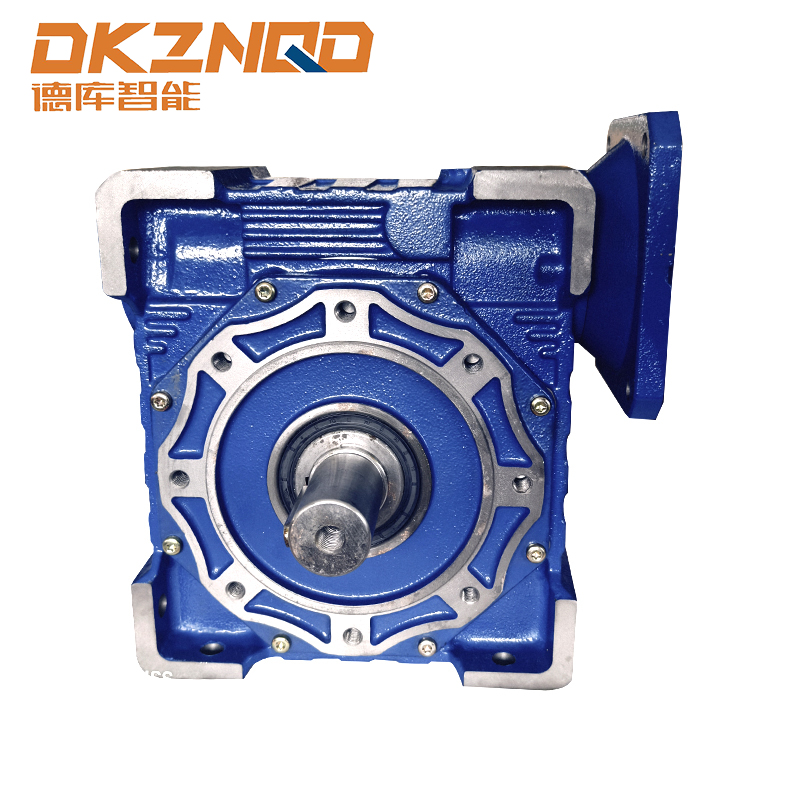
Standard Input Speed Range of NMRV Worm Gear Reducers
The input speed is a core performance parameter of the RV Worm Gear Reducer, which directly determines the matching range of driving motors, service life, transmission efficiency and operational stability of the entire reducer assembly. For standard industrial-grade NMRV worm gear reducers, the design and manufacturing are based on universal working conditions, and the input speed has a clear and standardized range.
In conventional industrial applications, the maximum allowable input speed for standard NMRV worm gear reducers is 1500 rpm, which is the most widely recognized and applied speed limit in the global industrial transmission field. This speed value matches the rated output speed of mainstream three-phase asynchronous motors, forming a highly compatible and cost-effective power transmission solution.
Under special customized working conditions, some reinforced NMRV reducer models can support a short-term maximum input speed of 1800 rpm, but this is not applicable to standard versions. Standard products strictly follow the 1500 rpm upper limit to ensure safe and continuous operation without abnormal wear, overheating or noise exceeding standards.
The minimum input speed of standard NMRV reducers is generally not less than 300 rpm. Operating below this speed for a long time will lead to insufficient lubrication film formation, increased friction between worm and gear, and accelerated damage to transmission components. The 300-1500 rpm interval is the optimal and safest input speed range for standard NMRV models.
Classification of Maximum Input Speed by NMRV Reducer Frame Sizes
The NMRV worm gear reducer series is divided into multiple frame sizes according to installation dimensions, output torque and application scenarios. Different frame sizes correspond to different maximum input speed limits, which are formulated based on structural strength, heat dissipation performance and material carrying capacity.
Small Frame Size NMRV Reducers (NMRV 025-NMRV 050)
Small-sized reducers are suitable for light-load, small-space transmission scenarios. Their maximum input speed is consistent with the general standard, fixed at 1500 rpm. Due to their compact structure, smaller worm diameter and lighter moving parts, they can run stably at the upper speed limit without excessive centrifugal force or vibration.
- NMRV 025: Max input speed 1500 rpm
- NMRV 030: Max input speed 1500 rpm
- NMRV 040: Max input speed 1500 rpm
- NMRV 050: Max input speed 1500 rpm
Medium Frame Size NMRV Reducers (NMRV 063-NMRV 090)
Medium-sized reducers are used in general industrial equipment with medium load. The standard maximum input speed remains 1500 rpm. These models have enhanced heat dissipation structures and thicker box walls, which can effectively control temperature rise when operating at rated maximum speed.
- NMRV 063: Max input speed 1500 rpm
- NMRV 075: Max input speed 1500 rpm
- NMRV 090: Max input speed 1500 rpm
Large Frame Size NMRV Reducers (NMRV 110-NMRV 150)
Large-sized reducers are designed for heavy-load and high-torque applications. Considering the larger mass of internal transmission parts, the standard maximum input speed is still 1500 rpm, but continuous operation at this speed requires matching with a forced cooling device to ensure performance stability.
- NMRV 110: Max input speed 1500 rpm
- NMRV 130: Max input speed 1500 rpm
- NMRV 150: Max input speed 1500 rpm
| Reducer Model | Frame Size | Max Input Speed (rpm) | Application Type |
| NMRV 025-050 | Small | 1500 | Light Load |
| NMRV 063-090 | Medium | 1500 | Medium Load |
| NMRV 110-150 | Large | 1500 | Heavy Load |
Critical Factors Limiting the Maximum Input Speed of NMRV Reducers
The maximum input speed of standard NMRV worm gear reducers is not set arbitrarily, but is restricted by multiple inherent structural and material factors. Understanding these factors is crucial for B2B buyers to select, install and use reducers correctly.
Heat Dissipation Performance of the Reducer
Heat generation is the most direct factor limiting input speed. When the RV Worm Gear Reducer runs at high speed, the friction between the worm and gear increases sharply, converting mechanical energy into heat energy. Standard NMRV reducers adopt natural heat dissipation with an aluminum alloy box, and the heat dissipation efficiency has an upper limit.
When the input speed exceeds 1500 rpm, the internal temperature of the reducer will rise rapidly. Excessive temperature will cause lubricating oil to thin, seal aging, and material thermal deformation, eventually leading to failure. The 1500 rpm limit ensures that the operating temperature is controlled within the safe range of -10℃ to 90℃.
Worm and Gear Material Strength
Standard NMRV reducers use high-quality alloy steel for the worm and high-strength brass for the gear, which have excellent wear resistance and toughness. However, under high-speed rotation, the centrifugal force and contact stress between transmission parts increase exponentially.
Exceeding the maximum input speed will cause fatigue damage to the material surface, pitting corrosion, tooth breakage and other faults. The 1500 rpm standard is formulated to match the fatigue strength limit of the standard configuration materials, ensuring a service life of more than 10,000 hours under normal working conditions.
Bearing Capacity and Service Life
The input shaft of the NMRV reducer is equipped with high-precision rolling bearings, which bear radial and axial loads during rotation. High-speed operation will increase the friction and wear of the bearing rolling elements and raceways.
The standard bearing configuration is designed for a maximum speed of 1500 rpm. Exceeding this speed will shorten the bearing service life by more than 50%, increase mechanical noise, and cause shaft deflection, affecting transmission accuracy.
Lubrication System Limitations
Standard NMRV reducers use splash lubrication, which relies on the rotation of the worm to drive lubricating oil to lubricate all friction pairs. The lubrication effect is directly related to the input speed.
Too low speed leads to insufficient lubrication, while too high speed causes oil splashing disorder and air mixing, reducing the lubrication performance. The 1500 rpm is the optimal speed for the splash lubrication system to form a complete and stable lubrication film.
Operational Noise and Vibration Control
Industrial equipment has clear requirements for noise and vibration. Standard NMRV reducers control the operating noise within 55-65 dB at 1500 rpm input speed, meeting indoor and noise-sensitive application standards.
When the input speed exceeds the limit, vibration amplitude increases, meshing noise rises sharply, and even resonance occurs, which not only affects the working environment but also loosens connecting parts and damages the installation structure.
Consequences of Exceeding the Maximum Input Speed for Standard NMRV Reducers
For B2B industrial buyers, operating the reducer beyond the rated maximum input speed is a high-risk behavior that will lead to a series of performance degradation and equipment failures, increasing maintenance costs and production downtime.
Severe overheating is the first and most obvious consequence. The internal temperature of the reducer will exceed 100℃ in a short time, causing the lubricating oil to deteriorate and lose lubricity, and the oil seal to soften and leak oil. Continuous high-temperature operation will directly burn out the worm and gear pairs.
Sharp reduction in service life is another critical impact. Test data shows that operating a standard NMRV reducer at 1800 rpm for a long time will reduce its service life from 10,000 hours to less than 2,000 hours, and the replacement cycle of wearing parts is shortened by more than 80%.
Transmission efficiency decline is also unavoidable. The rated transmission efficiency of standard NMRV reducers at 1500 rpm is 70%-85%. Exceeding the speed limit will increase mechanical loss, and the efficiency will drop below 60%, resulting in increased energy consumption and higher operating costs.
Mechanical failure and safety risks are the most serious consequences. High-speed operation may cause tooth breakage, shaft fracture, bearing damage and other sudden failures, leading to equipment shutdown and even personal safety hazards in severe cases.
- Oil leakage caused by high-temperature seal failure
- Severe wear and pitting corrosion of worm and gear surfaces
- Bearing locking and input shaft bending deformation
- Increased noise and vibration exceeding industrial standards
- Complete failure of the reducer requiring full replacement
Guidelines for B2B Buyers: Selecting Input Speed for NMRV Worm Gear Reducers
As a B2B buyer, choosing the appropriate input speed for the RV Worm Gear Reducer is the key to ensuring equipment matching, long-term stable operation and cost control. The following practical guidelines are tailored for industrial procurement and application scenarios.
Match Motor Speed Strictly
The most recommended configuration is to match the standard three-phase asynchronous motor with a rated speed of 1500 rpm, which is fully compatible with the maximum input speed of the NMRV reducer. This matching scheme has the highest universality, the lowest procurement cost and the most convenient after-sales maintenance.
For low-speed requirements, it is recommended to use a motor with a speed reducer or a variable frequency motor to adjust the output speed to the 300-1500 rpm range, rather than directly using a ultra-low-speed motor to drive the reducer.
Determine Speed According to Working Conditions
For continuous operation (24 hours a day), it is recommended to control the input speed at 1200-1400 rpm, which is 10% lower than the maximum limit, effectively reducing heat generation and wear and extending the service life.
For intermittent operation (8 hours a day), the input speed can be set to the rated maximum of 1500 rpm to give full play to the transmission performance of the reducer.
For high-temperature, high-humidity and heavy-load harsh environments, the input speed should be reduced by 15%-20% on the basis of the standard to adapt to the deteriorating operating environment.
Confirm Speed Parameters Before Procurement
B2B buyers must confirm the following speed-related parameters with suppliers before placing an order to avoid mismatching:
- Rated maximum input speed of the reducer
- Optimal input speed range for target working conditions
- Speed ratio and corresponding output speed
- Allowable speed fluctuation range
- Customized speed modification requirements (if any)
Installation and Commissioning Speed Specifications
During installation and commissioning, the input speed should be gradually increased from low to high. First run at 500 rpm for 30 minutes, then increase to 1000 rpm for 1 hour, and finally adjust to the rated working speed. This running-in process can protect the internal transmission components.
During commissioning, real-time monitoring of temperature, noise and vibration is required. If abnormalities occur, immediately reduce the speed and stop the machine for inspection to avoid irreversible damage.
How to Extend Service Life at Maximum Input Speed
When the standard NMRV worm gear reducer needs to operate at the maximum input speed of 1500 rpm for a long time, B2B users can take targeted measures to ensure stable performance and extend service life without changing the reducer structure and parameters.
Regular lubricating oil replacement is the most effective measure. For long-term high-speed operation, replace the special gear oil every 3000 hours, and check the oil quality and oil level every 500 hours. Use high-viscosity-index lubricating oil to maintain stable lubrication performance at high temperatures.
Enhance heat dissipation conditions can effectively control temperature rise. Install a cooling fan at the input end, keep the reducer installation environment ventilated and unobstructed, avoid direct sunlight and close to high-temperature equipment, and keep the surface of the box clean to ensure heat dissipation efficiency.
Regular inspection and maintenance is essential. Check the fastening of connecting bolts every month, check the wear of bearings and oil seals every 6 months, and replace worn parts in a timely manner. Regular maintenance can detect potential faults in advance and avoid sudden shutdowns caused by high-speed operation.
Control load within rated range is a basic prerequisite. Operating at maximum speed with overload will multiply the damage to the reducer. Ensure that the actual working load is lower than the rated output torque of the reducer to achieve the best matching of speed and load.
Comparison of Input Speed Between Standard and Customized NMRV Reducers
To help B2B buyers clearly distinguish the applicable scenarios of standard and customized models, we compare the input speed parameters and characteristics of the two types of RV Worm Gear Reducer.
| Parameter | Standard NMRV Reducer | Customized NMRV Reducer |
| Max Input Speed | 1500 rpm | 1800-3000 rpm |
| Heat Dissipation Mode | Natural Cooling | Forced Cooling/Fan Cooling |
| Bearing Type | Standard Rolling Bearing | High-Speed Precision Bearing |
| Application Scope | General Industrial Equipment | Special High-Speed Equipment |
| Procurement Cost | Low, Cost-Effective | High, Customized Charges |
| Delivery Time | Short, In Stock | Long, Custom Production |
Standard models are suitable for 95% of general industrial applications, with sufficient speed performance, high cost performance and short delivery time, which is the first choice for most B2B buyers. Customized models are only suitable for special high-speed scenarios and require additional design and manufacturing, with higher costs.
If the actual working speed exceeds 1500 rpm, it is not recommended to modify the standard reducer privately, but to purchase a customized high-speed model to ensure operational safety and performance compliance.
Industrial Application Cases of NMRV Reducer at Maximum Input Speed
The standard NMRV worm gear reducer operating at the maximum input speed of 1500 rpm is widely used in various industrial fields, providing stable and reliable transmission solutions for different equipment.
Food Processing Machinery
In food mixing, conveying and packaging equipment, the reducer runs at 1500 rpm input speed, with low noise and no oil leakage, meeting food hygiene standards. The compact structure saves installation space, and the stable transmission ensures the accuracy of food processing.
Packaging and Printing Equipment
Packaging machines, labeling machines and printing presses require high-speed and stable transmission. The NMRV reducer at 1500 rpm input speed achieves precise speed reduction and torque increase, ensuring the synchronization and accuracy of equipment operation.
Conveyor Systems
Light and medium-duty conveyor lines use standard NMRV reducers with 1500 rpm input speed, which can drive the conveyor belt continuously and stably, with low energy consumption and low failure rate, suitable for long-term industrial production.
Textile Machinery
Textile equipment requires smooth transmission and low noise. The reducer operating at the maximum input speed meets the high-speed production requirements of the textile industry, with stable performance and no impact on textile quality.
Automation Production Lines
Various automated assembly lines and robotic arms use NMRV reducers as transmission components. The 1500 rpm input speed matches the servo motor and variable frequency motor perfectly, realizing flexible and efficient automatic production.
Frequently Asked Questions About NMRV Reducer Maximum Input Speed
Q1: What is the maximum input speed of a standard NMRV worm gear reducer?
A: The maximum input speed is 1500 rpm for all standard frame sizes.
Q2: Can I run a standard NMRV reducer at 1800 rpm for a long time?
A: No, it will cause overheating, wear and shorten service life; only customized models support this speed.
Q3: What is the optimal input speed range for long-term operation?
A: 1200-1400 rpm, 10% lower than the maximum limit, for extended service life.
Q4: Does input speed affect the transmission efficiency of the reducer?
A: Yes, maximum speed provides the highest efficiency; exceeding or being too low reduces efficiency.
Q5: What happens if the input speed is lower than 300 rpm?
A: Insufficient lubrication, increased friction, accelerated wear and poor transmission stability.
Q6: Do large NMRV models have a lower maximum input speed?
A: No, all standard models share the same 1500 rpm maximum input speed limit.
Q7: How to monitor if the input speed is within the safe range?
A: Use a tachometer to measure motor output speed and check temperature, noise and vibration regularly.
Q8: Can lubrication upgrades allow higher input speed for standard reducers?
A: No, speed is limited by structure, material and bearings; lubrication only improves operation at rated speed.
Q9: Is 1500 rpm suitable for 24-hour continuous operation?
A: Yes, with regular maintenance and proper heat dissipation, it can run continuously safely.
Q10: Are NMRV and RV worm gear reducers the same in input speed standards?
A: Yes, they belong to the same series and follow the same 1500 rpm maximum input speed standard.
 05 Jun,2025