

 ENG
ENG
 English
 русский
 Español
 Türk
Türk

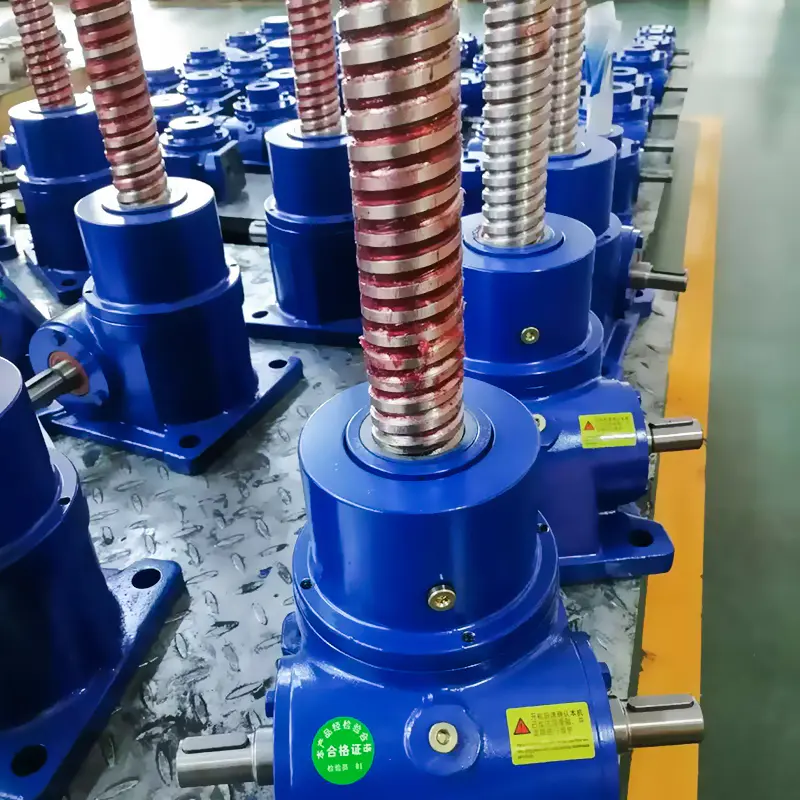
Defining Two Mechanical Lifting Workhorses
When specifying industrial lifting systems for heavy loads, precise positioning, and reliable synchronization, engineers typically encounter two dominant mechanical solutions: the SWL Series Worm Gear Screw Lifter and the Electric Machine Screw Lift. While both convert rotary motion into linear actuation, their underlying engineering principles, performance characteristics, and application sweet spots differ significantly. This article delivers a technical, data-driven comparison to guide your selection process for heavy-duty industrial lift systems.
At the heart of mechanical lifting lies the worm gear drive. The worm gear catalog features numerous configurations, but the SWL Series stands out for its integrated worm gear reducer and self-locking capabilities. Meanwhile, the Electric Machine Screw Lift represents a broader category often paired with inline gearbox reducers and electric motors. Understanding their nuances ensures optimal system design, whether you need a single-point lifter or synchronized screw jack systems spanning multiple axes.
We will dissect their design architectures, compare load-speed-efficiency trade-offs through data visualizations, and explore real-world application scenarios. The focus remains on practical engineering considerations, backed by industry data and technical principles.
Design Architecture and Core Mechanical Principles
SWL Series Worm Gear Screw Lifter
The SWL Series Worm Gear Screw Lifter integrates a worm gear drive directly with a lifting screw within a compact housing. The worm drive electric motor typically connects via an input shaft, rotating a hardened steel worm that meshes with a bronze worm gear. This worm gear, in turn, drives the lifting screw through a nut mechanism. The design leverages the high reduction ratios possible with worm gearing, allowing a small motor to move substantial loads.
Key architectural features include:
- Self-Locking Capability: The inherent friction angle of the worm gear pair often provides self-locking, meaning the load stays in position without external brakes. This is critical for safety in hoisting applications.
- Multiple Configurations: Available in translating screw or rotating nut versions, with various screw end types (threaded, flanged, plain) to suit different load attachments.
- Dual Ratios: Standardized in normal (P) and slow (M) speed ratios, offering flexibility in speed versus torque trade-offs.
- Heavy-Duty Materials: Housings are typically high-strength cast iron, and the worm gear uses specialized bronze alloys like AlBC3 (aluminum bronze) for durability.
Electric Machine Screw Lift
The term Electric Machine Screw Lift often refers to screw jack systems driven by standard electric motors through external gearboxes. This category commonly pairs a motor with a separate inline gearbox reducer or a right-angle bevel gearbox. While the lifting screw mechanism may be similar to the SWL series, the drive train is modular. This design allows for a wider range of motor sizes and gear ratios.
Core architectural traits include:
- Modular Drive Train: Motor, reducer, and screw jack are separate components, allowing customization of each element.
- Flexible Mounting: Motor can be mounted coaxially via an inline gearbox or perpendicularly via a right-angle gearbox.
- High-Speed Options: Often paired with ball screws for applications requiring higher speeds and duty cycles, though acme screws are also common.
- Scalability: Systems can be scaled from fractional horsepower to hundreds of tons of lifting capacity using multiple jacks and connecting shafts.
Comparison of Design Features
| Feature | SWL Series Worm Gear Screw Lifter | Electric Machine Screw Lift |
|---|---|---|
| Drive Integration | Integrated worm gear reducer | Modular motor + gearbox (often inline or bevel) |
| Self-Locking | Inherent (most ratios) | Requires external brake or special gearing |
| Screw Type | Typically trapezoidal (acme) thread | Trapezoidal or ball screw options |
| Efficiency | Lower (30-70% depending on ratio) | Higher with ball screws; lower with acme + worm |
| Typical Load Range | 2.5 kN to 1200 kN (standard models) | Wide range; can exceed 100 tons with multiple jacks |
| Housing Material | Cast iron, aluminum (small models) | Cast iron, steel, aluminum |
Comparative Performance: Load, Speed, and Efficiency
Performance metrics are critical for selecting the right lifter. The following data visualizations illustrate the trade-offs between the two systems based on industry-standard specifications.
Load Capacity vs. Lifting Speed
The bar chart illustrates that Electric Machine Screw Lifts equipped with ball screws (EML-Ball) achieve significantly higher speeds at moderate loads. In contrast, the SWL Series Worm Gear Screw Lifter, especially in slow speed (M) ratio, offers very high load capacity but with reduced speed. This inherent trade-off is due to the sliding friction in worm gears versus the rolling friction in ball screws.
Efficiency Curves
Efficiency is a key differentiator. Electric Machine Screw Lifts with ball screws maintain high efficiency (above 80%) across a wide range of ratios, making them suitable for continuous operation. However, SWL Series Worm Gear Screw Lifters typically show efficiency between 30% and 70%, decreasing as the ratio increases. This lower efficiency is the price for self-locking and compact design.
Radar Chart: Multi-Parameter Comparison
The radar chart visualizes the trade-offs. The SWL Series Worm Gear Screw Lifter excels in load capacity and self-locking, making it ideal for static holding or infrequent heavy lifts. The Electric Machine Screw Lift with ball screws shows superior speed and efficiency but may require external braking for holding applications.
Synchronized Systems and Integration
For applications requiring coordinated movement across multiple points, both systems can be integrated into synchronized screw jack systems. However, the approach differs.
SWL Series in Multi-Jack Systems
SWL units are often connected using a linear motion bevel gearbox and connecting shafts. A single motor drives a central bevel gearbox that distributes power to multiple SWL jacks through shafting. This mechanical synchronization ensures all jacks move in exact unison without electronic controls. The self-locking nature of each SWL unit also ensures load holding across all points, even during motor power loss.
A typical synchronized system comprises:
- Central Motor: Single drive source.
- Bevel Gearboxes: Change drive direction by 90 degrees.
- Connecting Shafts: Transmit torque between jacks.
- Pedestal Bearings: Support long shafts to prevent deflection.
This setup is robust but requires careful alignment to avoid binding and uneven loading.
Electric Machine Screw Lift Configurations
Electric Machine Screw Lifts are also used in multi-point arrangements, often with ball screws for higher speeds. However, because ball screws are not self-locking, systems may incorporate brakes on the motor or use a worm gear reducer as the drive component to provide the necessary holding torque. Alternatively, electronic synchronization using servo motors and encoders can be employed for more flexible, programmable motion profiles, though this adds cost and complexity.
System Configuration Example
The flowchart depicts a basic synchronized system using an inline gearbox reducer followed by bevel gearboxes to drive multiple screw jacks. This configuration is common in heavy duty industrial lift systems such as stage lifts, material handling platforms, and industrial presses.
Application-Based Selection Criteria
Choosing between an SWL Series Worm Gear Screw Lifter and an Electric Machine Screw Lift depends on application-specific requirements. Here is a technical decision matrix:
| Application Requirement | Recommended System | Rationale |
|---|---|---|
| Infrequent lifts, high load holding, safety critical | SWL Series Worm Gear Screw Lifter | Self-locking provides inherent safety; lower efficiency acceptable for short duty cycles. |
| Frequent high-speed operation, high duty cycle | Electric Machine Screw Lift (Ball Screw) | Higher efficiency reduces heat generation and energy costs; allows faster cycle times. |
| Ultra-heavy loads (>100 tons), synchronized lifting | Both; but often Electric Machine with multiple jacks | Scalable with multiple units; mechanical synchronization via shafting is robust and proven. |
| Precise positioning, programmable motion profiles | Electric Machine Screw Lift with Servo | Servo motors and encoders enable closed-loop control; not typically available with standard SWL. |
| Compact footprint, single-point lifting | SWL Series Worm Gear Screw Lifter | Integrated design reduces space requirements. |
| Corrosive or harsh environments | Either with appropriate materials | Cast iron housings with protective coatings available for both. |
Engineering Insight: A leading automation manufacturer recently replaced a hydraulic system with a synchronized electric machine screw lift system using ball screws and servo motors. The result was a 30% increase in positioning accuracy and a 50% reduction in maintenance downtime, highlighting the advantages of mechanical screw lifting over hydraulic alternatives.
Visual Product Reference
Frequently Asked Questions
Q1: What is the primary advantage of the SWL Series Worm Gear Screw Lifter over an Electric Machine Screw Lift?
The primary advantage is its inherent self-locking capability. The worm gear geometry prevents the load from back-driving the motor, making it ideal for holding applications without external brakes. This is a critical safety feature in many lifting systems.
Q2: Can an Electric Machine Screw Lift be made self-locking?
Yes, but not inherently. To achieve self-locking, the system can be paired with a worm gear reducer or equipped with a motor brake. However, a worm gear reducer reduces efficiency, somewhat diminishing the speed advantage of the electric machine screw lift.
Q3: Which system is more efficient for continuous operation?
Electric Machine Screw Lifts with ball screws are significantly more efficient (up to 90%) compared to worm gear drives (30-70%). This makes them more suitable for applications with high duty cycles where energy costs and heat generation are concerns.
Q4: How do I synchronize multiple screw jacks in a system?
Mechanical synchronization uses a single motor driving multiple jacks through bevel gearboxes and connecting shafts. This ensures perfect phasing. Alternatively, electronic synchronization uses individual servo motors and encoders for each jack, offering programmability but at higher cost.
Q5: What are the load limits for these lifting systems?
SWL Series Worm Gear Screw Lifters are available from 2.5 kN to over 1200 kN (120 tons) per unit. Electric Machine Screw Lifts can handle similar ranges, and with multiple units in a synchronized system, total capacity can exceed 100 tons.
 05 Jun,2025