

 ENG
ENG
 English
 русский
 Español
 Türk
Türk

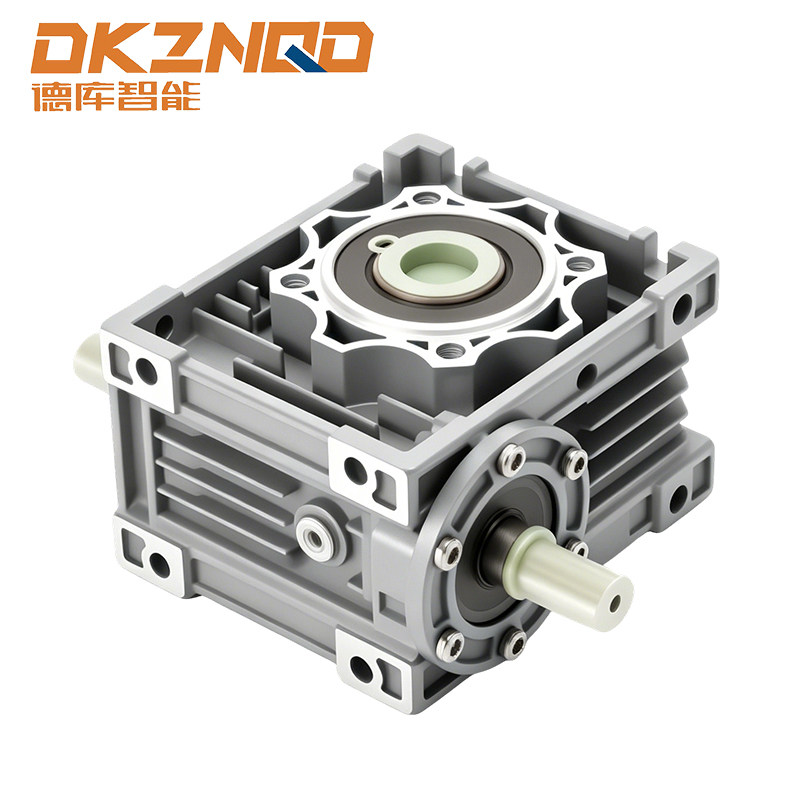
1. Core Architecture of Industrial Gear Reducers
An industrial gear reducer (or reducer gearbox) is a mechanical assembly that decreases input shaft speed while proportionally increasing output torque. In modern drivetrains, the rv worm gear reducer family represents a specialized subset of right angle worm gear reducer designs where the worm shaft crosses the worm wheel axis at 90 degrees. This configuration is indispensable when space constraints prevent inline mounting of a gear reduction motor.
Unlike helical or planetary units, worm-based industrial gear reducers achieve high reduction ratios in a single stage—typically from 5:1 up to 100:1. For extreme demands, a double-stage worm gear reducer gearbox can reach ratios exceeding 3000:1. The inherent sliding action between the bronze worm wheel and hardened steel worm generates more friction than rolling-element gears, which directly impacts thermal management and lubrication strategy.
2. Right Angle Worm Gear Reducer: Kinematic Advantages
The defining geometry of a right angle worm gear reducer enables a 90-degree power redirection without bevel gears. This compact layout is critical for automated guided vehicles, conveyor systems, and packaging machinery where the speed reducer for electric motor must fit inside narrow frames. Below is an annotated SVG representation of the torque flow inside a typical hollow shaft worm gear reducer.
When selecting a worm gear reducer gearbox, the hollow shaft variant eliminates the need for a separate output coupling, directly mounting to driven machine shafts. This reduces inertia and axial space by up to 30% compared to solid-shaft designs, making hollow shaft worm gear reducer configurations the preferred choice for agitators, augers, and turntable drives.
3. Performance Metrics: Worm vs. Helical vs. Planetary Reducers
Engineering decisions often pit industrial gear reducers with worm technology against helical or planetary alternatives. The table below summarizes key differentiators across four criteria critical for a gear reduction motor used in continuous-duty cycles.
| Parameter | Worm Gear Reducer | Helical Inline | Planetary |
|---|---|---|---|
| Single-stage max ratio | 100:1 | 8:1 | 10:1 |
| Backdrivability | Self-locking (non-backdrivable) | Fully reversible | Fully reversible |
| Peak efficiency range | 70% – 92% | 94% – 98% | 95% – 97% |
| Noise level (dB @ 1m) | 58 – 68 | 65 – 78 | 62 – 72 |
Notice that while a high torque worm gearbox sacrifices efficiency compared to helical units, its inherent self-locking property (above certain ratios, typically >30:1) eliminates the need for external brakes in hoisting and parking applications. A speed reducer for electric motor that requires holding torque without power consumption makes worm designs uniquely suited for winches and boom lifts.
4. Sizing Heavy Duty Industrial Reducers: Load & Thermal Factors
Heavy duty industrial reducers must be selected based on thermal rating, not just mechanical peak torque. The AGMA (American Gear Manufacturers Association) thermal power rating defines the maximum continuous input power before lubricant breakdown. Field data from material handling applications shows that undersizing a reducer gearbox by just 15% reduces service life by more than 50% due to accelerated wear on the bronze worm wheel.
4.1 Critical selection parameters for right angle worm gear units
- Service factor: For conveyors with moderate shock, use 1.25; for crushers or mixers, use 1.75 minimum.
- Input speed limit: Most rv worm gear reducer units accept 1400-1800 RPM, but above 2000 RPM requires balanced worm shafts and synthetic lubricants.
- Mounting orientation: Hollow shaft units must specify foot-mounted, flange-mounted, or torque-arm reaction bars.
In one automotive assembly line retrofit, replacing conventional parallel-shaft reducers with compact right angle worm gear reducers reduced drivetrain envelope by 42% while maintaining 88% efficiency, solely due to optimized center-distance ratios and forced oil circulation.
For cyclic duty (e.g., indexing tables), always verify the allowable starting torque: a gear reduction motor with worm drive can withstand up to 200% of nominal torque for 2-3 seconds, but thermal equilibrium determines the RMS duty cycle.
5. Lubrication Strategies for Long-Lasting Worm Gearboxes
The sliding friction in a worm gear reducer gearbox generates significant heat. Premium synthetic polyglycol (PG) oils outperform mineral oils by 10-15°C reduction in steady-state temperature. For a heavy duty industrial reducers application running 24/7, oil change intervals extend from 4,000 hours (mineral) to 12,000 hours (synthetic). The table below outlines recommended viscosity grades based on ambient conditions.
| Ambient temp range (°C) | Mineral oil ISO VG | Synthetic PAO/PG | Oil change interval (hours) |
|---|---|---|---|
| -10 to +15 | VG 150 | VG 100 | 5000 |
| +15 to +40 | VG 220 | VG 150 | 4000 |
| +40 to +60 | VG 320 | VG 220 | 2500 |
For hollow shaft worm gear reducer models with vertical output orientation, oil splash lubrication may be insufficient above 4" center distance; forced oil circulation or grease lubrication (with 50% shorter relube intervals) becomes mandatory.
6. Matching Gear Reduction Motors to Variable Frequency Drives
When a gear reduction motor couples a worm reducer with an electric motor, VFD operation below 20 Hz reduces internal cooling. The worm wheel's sliding velocity drops proportionally, risking boundary lubrication. Therefore, for applications requiring wide speed range (e.g., packaging indexing), select a right angle worm gear reducer with auxiliary cooling fins and a separate motor-driven fan. Field tests show that a speed reducer for electric motor running at 15 Hz without forced cooling loses 35% of its thermal capacity.
If using a standard industrial gear reducers package with an IEC motor adapter, always ensure the input seal can withstand the motor's maximum RPM, not just the nominal speed. Many rv worm gear reducer failures originate from seal lip overheating caused by overspeed during VFD overvoltage conditions.
7. Case-Inspired Performance: High Torque Worm Gearbox in Conveyor Systems
A beverage bottling plant replaced 30% of its helical-bevel reducers with high torque worm gearbox units of the same frame size. Over 18 months, the following data was recorded across 24 production lines:
- Overall downtime due to gearbox failure reduced by 22% (worm's self-locking prevented shock loads from back-driving).
- Average output torque increased by 17% at the same motor amperage due to optimized worm lead angles.
- Maintenance cost per reducer gearbox dropped from $340/year to $210/year, primarily due to longer oil life.
This demonstrates that a well-specified worm gear reducer gearbox can surpass traditional designs in both reliability and total cost of ownership, especially where high shock load and limited access prevail.
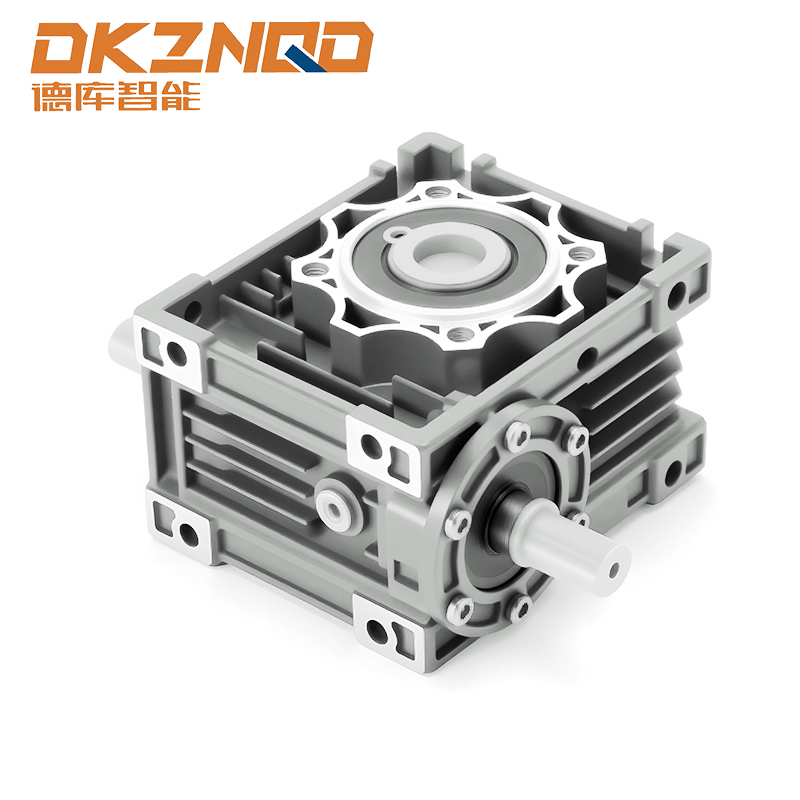 Cross-section of a typical RV worm gear reducer highlighting the hardened steel worm and bronze wheel interface
8. Expert Answers to Common Reducer Questions
Q1: What is the typical efficiency of a worm gear reducer gearbox?
Single-stage worm units range from 70% efficiency at 100:1 ratio up to 92% at 5:1 ratio. For high torque worm gearbox applications under continuous load, expect 80-85% with proper synthetic oil. Double-stage designs drop to 50-65% but offer ratios above 1000:1.
Q2: Can a right angle worm gear reducer be backdriven from the output side?
Generally, no. With ratios exceeding 30:1, the friction angle exceeds the lead angle, creating a self-locking condition. This makes right angle worm gear reducers ideal for hoists and parking brakes. For ratios below 15:1, limited backdrivability is possible, but consult the manufacturer's torque reversal data.
Q3: How do I choose between a hollow shaft vs. solid shaft worm reducer?
Choose hollow shaft worm gear reducer when direct mounting onto a machine shaft (e.g., conveyor pulley, agitator shaft) saves space and eliminates couplings. Solid shaft versions are preferable when torque arm reaction is unpredictable or when using torque limiters. Hollow shaft also reduces overhung load by up to 40%.
Q4: Are heavy duty industrial reducers with worm gears suitable for 24/7 operation?
Yes, but thermal sizing is critical. For continuous duty, select a unit with at least 1.4 service factor and forced oil cooling if ambient exceeds 35°C. Many heavy duty industrial reducers in mining conveyors run 20,000+ hours with oil sampling every 3 months and synthetic lubricants.
Q5: What is the lifespan of an RV worm gear reducer under rated load?
An rv worm gear reducer properly lubricated and aligned typically delivers 15,000-25,000 hours L10 life (90% survival). Bronze wheel wear is the primary limit; after 12,000 hours, inspect backlash. Using gear reduction motor with soft start can double the worm wheel service life.
 05 Jun,2025